
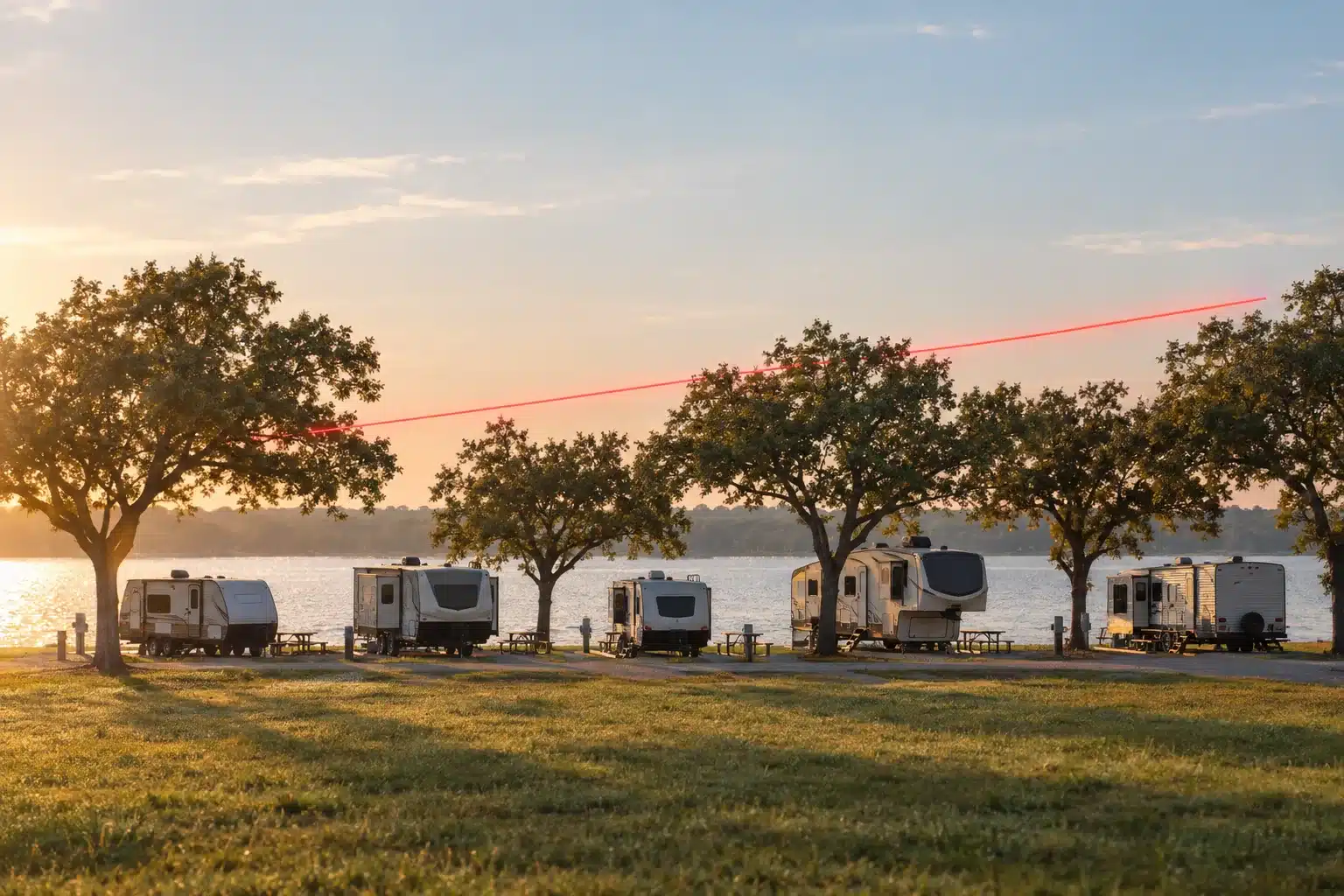
Sunset View RV Resort is a few minutes from Lake Texoma in Kingston, Oklahoma. It has a pool, a pickleball court, a stocked fishing pond, a dog park and monthly sites, and it’s a short drive from several casinos. In other words, a good park that deserved more guests than it was getting from search. The owners handed us their website and search in October 2025. This RV resort digital marketing case study covers what we changed and what happened through the first half of 2026.
The short version: booking revenue for January through June 2026 doubled compared with the same months of 2025.
| What we measured | Result |
|---|---|
| Booking revenue, Jan-Jun 2026 vs. the same months of 2025 | 2x |
| Clicks from Google search, Jan-Jun 2026 | 2.6x |
| Times the resort appears in Google search | 40,000+ a month |
Where the resort started
Plenty of guests found Sunset View the old-fashioned way. They drove past it, or somebody at the lake mentioned it. That works fine in July.
It works a lot less in January. The weekend crowd thins out and a lake park lives on people who plan ahead: snowbirds, monthly guests, work crews on long jobs, couples booking a casino weekend. Those guests search before they drive. When they searched, the resort didn’t show up the way a park with its amenities should have, and the old website didn’t make a strong case once they got there. It didn’t clearly say what the park offered, who it was built for, or how to book from a phone.
What we did
Nothing exotic. Most of this is the same work any local business needs. It just had to fit the way RV travelers shop, which is on a phone, comparing three or four parks, often from the cab of a truck.
A new website built around how guests book
We rebuilt the site from the ground up. Different guests get pages that answer their own questions: weekend visitors, long-term and monthly stays, and crews who need a place to park near a job site. Amenities, rules, directions and things to do nearby sit where people expect them, and booking is one tap away on any page. That’s the approach behind every website we design: figure out who is actually searching, then give each of them a page.
Local search
We rewrote titles and page copy around the searches travelers really run, like RV parks near the lake, near the casinos, and monthly RV sites in the area, and built the new site so Google could read it cleanly: fast pages, clear headings, one topic per page. This is the slow, unglamorous part of local SEO. It’s also the part that compounds.
Google Business Profile and reviews
For a campground, the map listing does a lot of the selling before anyone reaches the website. People see the photos, the star rating and the most recent reviews, and a lot of them decide right there. We cleaned up the resort’s Google Business Profile: categories, amenities, hours, current photos and regular posts. We also set up a routine for asking guests for reviews and answering the ones that come in, good or bad.
If you want to do the profile work yourself, our guide to optimizing a Google Business Profile in 2026 walks through it field by field.
The results
Search moved first. Clicks from Google search grew 2.6x over January through June 2026, and the resort now shows up in Google more than 40,000 times a month. Those are people looking for a place to stay around Lake Texoma and seeing Sunset View in the results.
Revenue is the number the owners care about, and it followed. Booking revenue for January through June 2026 was double what the same six months brought in during 2025. Those months include the slowest stretch of the year for a lake park, the same stretch where drive-by traffic used to dry up.
What an RV resort digital marketing case study can and can’t tell you
We’d be suspicious of any agency that took credit for every dollar of a doubling. Rates change. Weather changes. One rainy spring can wreck a season for everybody on the lake. What we can say is that far more people found the resort on Google, they landed on a site that made booking easy, and revenue rose over the same months.
When you read any agency’s case study, ours included, check when the work started, what the comparison period is, and whether the results are the ones the owner would actually put on a bank deposit slip. Rankings for a handful of hand-picked keywords are nice. Revenue against the same months last year is better.
What carries over to other seasonal businesses
If you run anything seasonal around Lake Texoma, like a marina, a boat rental, cabins, an event venue or a guide service, the slow months are where marketing earns its keep. Summer customers find you anyway. Off-season customers plan, and planners search.
- Give each type of off-season customer its own page. A monthly guest and a weekend guest ask completely different questions.
- Keep your Google Business Profile current all year, with hours and photos that match the season.
- Ask for reviews during your busy months, so the profile still looks active when things are quiet.
- Watch search clicks and calls month over month. You’ll see which months need a push before the bank balance tells you.
None of that requires a big budget. It does require somebody to keep doing it after the first month, which is usually where seasonal businesses fall off.