
Category: SEO

  • The 30-Minute Local SEO Audit for Texoma Business Owners

    The 30-Minute Local SEO Audit for Texoma Business Owners

    We get some version of this call a lot: an owner in Sherman or Denison is sure the website is broken because the phone went quiet. Usually it isn’t. Usually it’s three or four small, boring things. A business category picked in a hurry years ago. A phone number that doesn’t match across directories. A services page that never once says “Denison.” An owner can find every one of them with a local SEO audit that takes half an hour.

    No paid tools, no technical background. Grab your phone, open a notes app, and set a timer.

    Minutes 1 to 5: search like a customer

    Open a private browsing window on your phone and search the way a customer would: the service and the city, not your business name. “Roof repair Sherman TX.” “Dentist Denison.” “Emergency plumber near me.”

    Write down three things. Whether you show up in the map pack (the three businesses listed under the map). Where you land in the regular results below it. And who’s above you. That last one tells you what kind of fight you’re in. Losing to national chains with hundreds of reviews is a different problem from losing to a two-truck outfit out of Pottsboro.

    Look at the very top of the page, too. On a lot of searches Google now shows an AI Overview before anything else. Note whether it names you, and which businesses it does name. If it names competitors and never you, that’s a gap worth knowing about, and it’s the one our AI search optimization work goes after.

    Repeat all of this for your three highest-margin services. Owners tend to check the service they’re proudest of, and it’s rarely the one paying the bills.

    Minutes 5 to 12: the Google Business Profile fields nobody fills in

    Open your Google Business Profile and look at it the way a stranger would.

    • Primary category. Is it the most specific option that’s accurate? “Roofing contractor” beats “Contractor.” Whitespark’s 2026 Local Search Ranking Factors survey put the primary category first on its list of factors for map rankings, so don’t guess on this one.
    • Additional categories. Most businesses use one or none. Add each one that honestly describes work you do, and nothing you don’t.
    • Services. Every service you offer should be listed, with a real description.
    • Photos. When did you last add one? If it’s been months, customers can tell.
    • Hours, holiday hours included. If Google isn’t sure you’re open on a holiday it may warn searchers that your hours might differ, and some of them will just call somebody else.

    While you’re in there, open the performance section and find the list of searches that showed your business. Those are the words people actually typed. There’s often a service on that list you don’t have a page for. We go through every field in more detail in how to optimize your Google Business Profile in 2026.

    Row of rural mailboxes along a farm road on an overcast day, one crooked and out of line, with a thin red line of light broken above it

    Minutes 12 to 18: check your name, address and phone everywhere

    Search your business name in quotes and click through the first ten or so results that aren’t your own site. Yelp, Facebook, Apple Maps, Bing Places, the BBB, the chamber directory, and whatever directories exist for your trade.

    You’re hunting for mismatches. An old suite number. The phone number from before you switched carriers. “LLC” on some listings and not others. A Sherman address two years after you moved to Denison.

    Google uses these listings to cross-check who and where you are. When they disagree, it trusts your information less, and AI tools pulling from the same directories get confused the same way. The work is dull. It’s also often one of the best-returning fixes on this whole list. Start with the listings customers actually use (Facebook, Apple Maps, Bing, Yelp) and work down from there.

    Minutes 18 to 23: reviews, and read the dates

    Everybody checks their star rating. Almost nobody checks when the reviews came in.

    A business with 140 reviews and nothing newer than March looks worse to a customer than one with 45 reviews and six from the past month. Google cares about this too: recency of reviews lands in the top dozen map-ranking factors in the same Whitespark survey. Count how many reviews you’ve gotten in the last 90 days, then do the same for the top competitor you wrote down in minute three.

    Then check whether you’ve replied to them. Unanswered reviews, especially bad ones, are the cheapest problem on this list and one of the first things a customer reads when choosing between you and the shop up the road.

    Minutes 23 to 28: what your website says about where you are

    Pull up your own site on your phone and go down this list:

    • Does the title in the browser tab name a service and a city? “Home” is a wasted title.
    • Does each major service have its own page, or is everything crammed onto one Services page? A page ranks for what it’s about, and a page about everything is about nothing in particular.
    • Are your address and phone number in the footer as real text, not part of an image?
    • Does the phone number dial when you tap it?
    • How long does the homepage take to load on cell data, away from the office wifi? If you’re drumming your fingers, so is everyone else.
    • Does the site mention every town you actually serve? If you work in Denison and only Sherman appears anywhere, read why you rank in Sherman but not Denison.

    Minutes 28 to 30: rank the fixes

    You now have a list. Don’t try to do all of it this week. Work it in this order:

    1. Anything factually wrong: phone, address, hours. These cost you customers today.
    2. Empty Google Business Profile fields. Free, fast, and the categories matter most.
    3. Review recency. Start asking every satisfied customer, this week.
    4. Directory mismatches. Tedious, but the fixes add up.
    5. Website structure and speed. The biggest lift and the slowest payoff. Still worth doing.

    What a 30-minute local SEO audit won’t catch

    Half an hour won’t turn up technical problems like broken schema markup or pages Google never indexed. It won’t show you a competitor quietly collecting links from every chamber, church and youth league in Grayson County. It can’t tell you whether the traffic you do get turns into calls. And it won’t show you the searches in Van Alstyne, Whitesboro and Pottsboro where you never appear at all. That deeper layer is where a real SEO engagement starts.

    What it will do is keep you from paying anyone to fix things you could have handled yourself on a Tuesday morning. Run it again every quarter. The second time takes about fifteen minutes.

  • Multi-City Local SEO: Why You Rank in Sherman, Not Denison

    Multi-City Local SEO: Why You Rank in Sherman, Not Denison

    Search “HVAC repair Sherman TX” from your office and there you are: top of the map, five stars, phone number one tap away. Then a homeowner a few exits up US-75 searches the same thing from Denison and you’re gone. Not on page two. Not in the map at all. That gap is what multi-city local SEO is about, and it’s the most common local search problem we see with Texoma businesses.

    Most owners decide their SEO is broken. It isn’t. Google is doing what it was built to do. You just haven’t given it a reason to show you in the next town.

    Why Google keeps you in one town

    Google says local results come down to relevance, distance and prominence. Relevance is how well your listing matches the search. Prominence is how well known you are, which Google says includes the links pointing to your site and your reviews. You can work on both.

    Distance is the one that traps you. Google measures from the person searching to the address on your Business Profile. If your shop is on Texoma Parkway in Sherman, every Denison search starts with you at a disadvantage, and a competitor with a Denison address starts at zero. That isn’t a penalty. Google assumes most people want someone close.

    You can’t move your shop. You can outwork the distance with the other two factors, and that’s what the businesses showing up in several Texoma towns are doing.

    Don’t rent a mailbox in Denison

    Somebody will suggest it: get a mailbox or a virtual office in the next town and list it as a second location. Google’s Business Profile guidelines say plainly that a virtual office isn’t eligible, and neither is a mailbox at a remote location. Competitors report these listings, and getting a suspended profile reinstated is slow and not guaranteed.

    A second profile is fine if you open a real location with staff and posted hours. If you do open a Denison office, claim it the week you open. Otherwise, build the honest way.

    What multi-city local SEO actually takes

    Set a realistic service area

    Your Google Business Profile lets you list service areas. Add the towns you really serve, say Sherman, Denison, Pottsboro, Whitesboro, Van Alstyne, Gunter, Howe and Bells. Google’s guidelines say the whole area generally shouldn’t reach past about two hours of driving from your base, and listing half of North Texas doesn’t help you anyway.

    Here’s the part most people don’t know. The service area setting doesn’t appear to move rankings at all. Sterling Sky, a local search firm that tests this kind of thing, found rankings still follow the verified address, not the towns in your list. Set it so customers can see where you work, then get on with the rest of this.

    A brick-paved small-town main street with a service van at the curb and a thin red light outlining one storefront doorway.

    Build real city pages

    City pages work. Copies don’t. A doorway page is your Sherman page with “Sherman” swapped for “Denison” everywhere, and Google’s spam policies call out exactly that pattern.

    A real city page has things you could only write about that town:

    • Photos from jobs there, with the neighborhood named
    • Reviews from customers who live there
    • Local conditions that change the work, like older homes near downtown Denison or the new construction on Sherman’s north side
    • How fast you can actually get there, and whether there’s a trip charge
    • A landmark or two, where it comes up naturally

    Three good city pages beat fifteen thin ones. Start with the two or three towns that bring in the most revenue and write those properly.

    Earn a reputation in the town you want

    Prominence is local. If you want to rank in Denison, you need Denison websites and Denison people talking about you.

    Join the Denison chamber, not just Sherman’s. Sponsor a youth team or a school fundraiser and make sure the sponsor page links to your site. Get quoted in the local paper. Trade links with a business across town that does related work. Show up at community events that list their vendors online. It’s slow, unglamorous work, and it’s the hardest thing for a competitor to copy.

    Clean up your listings

    Your name, address and phone number sit on dozens of sites: Apple Maps, Bing Places, Yelp, industry directories, the chamber, old listings you forgot about. Every one that says “Ste 5” instead of “Suite 5,” or still shows a phone number you dropped years ago, muddies the picture Google has of your business.

    Pick one exact format, fix the major directories, and then leave them alone. It’s a tedious weekend, and it’s part of every local SEO project we take on.

    Ask for reviews that name the town

    “Great service” helps your rating. “They made it out to our place in Denison the same afternoon” helps the rating and ties you to Denison.

    You can’t write reviews for customers, and you shouldn’t try. You can ask a better question. Instead of “please leave us a review,” try “If you have a minute, it helps a lot if you mention what we did and what town you’re in.” Most people are happy to. Our post on why online reviews are the new word of mouth covers the rest of the review process.

    Stop checking rankings from your office

    Searching your own keywords at your desk tells you almost nothing. You’re sitting on top of your business, so Google shows you a result no customer across town will ever see.

    Use a grid-based rank tracker that shows your position at points across a map. Look at the search terms in your Business Profile’s performance report. Filter your Search Console queries by town name. And now and then, do it the low-tech way: park at a gas station in Denison and search.

    How long it takes

    Longer than you’d like. Listing cleanup and new city pages can show up within weeks. The reputation work (links, reviews, sponsorships) builds slowly and then holds. Crowded trades like HVAC, plumbing and roofing take the longest.

    For a sense of the early stretch: after we launched a new site for Cole’s Pest Control in Bossier City, Louisiana, in June 2026, the number of search terms they ranked for went from 49 to 67 by August. That’s the kind of movement you see first. Winning the map in a neighboring town takes longer.

    Anyone promising you the Denison map pack in thirty days is doing something risky or telling you what you want to hear.

    Pick your towns by revenue

    Before you build anything, look at where your best jobs come from. Check the drive times and whether the margin survives them. Look for towns where the competition is weak. For most Texoma businesses the honest answer is two or three towns, usually Sherman, Denison and one more.

    Own those before you add more. Being the obvious choice in two towns beats being faintly visible in eight.

  • AI Search for Local Business: Getting Found in Texoma

    AI Search for Local Business: Getting Found in Texoma

    A few years ago, someone in Sherman with a leaking water heater Googled “plumber near me” and called whoever showed up first. Plenty of people still do. But a growing number type the question into ChatGPT, Gemini or Google’s AI Mode instead: “Who’s a good HVAC company in Denison?” They get back a short answer naming two or three businesses. That’s what AI search looks like for a local business, and if your name isn’t in that answer, you never got the chance to compete.

    This already happens a lot. BrightLocal’s 2026 Local Consumer Review Survey found 45% of consumers now use ChatGPT and similar tools to get local business recommendations, up from 6% a year earlier. On Google itself, a Pew Research Center study found that when an AI summary appeared at the top of the results, people clicked a regular link about half as often (8% of visits versus 15%). The answer is doing more of the work and the list of links is doing less.

    Getting into those answers isn’t magic, though. And from what we see, most Texoma businesses haven’t started working on it.

    How AI search picks a local business to recommend

    AI tools don’t have favorite roofers. When someone asks for “the best roofing company in Sherman,” the tool pulls from public information you mostly control: your Google Business Profile, your website, your reviews, directory listings and mentions of your business around the web. It blends all of that into a few sentences.

    So the groundwork is the same as local SEO. Some signals just count for more. Three stand out:

    • Consistency. Your business name, address, phone number and services should match everywhere they appear. These tools cross-check sources, and conflicting details make you look less reliable.
    • Reviews that say something. AI reads the text, not just the stars. “Fixed our AC in one visit, fair price, showed up on time” tells it exactly what you’re good at. Fifty reviews that say “Great!” tell it almost nothing.
    • Plain, specific website copy. “We proudly serve the community with quality solutions” could describe a bank or a bakery. “We repair and replace home HVAC systems in Sherman, Denison and Pottsboro” can’t be misread.

    If you want the longer version of how this differs from classic SEO, we covered it in GEO vs SEO. Our AI search optimization page explains how we handle it for clients.

    Make your website answer questions

    These tools are built to answer questions, so they favor pages that answer them directly. Read your main service page and ask: if a customer only saw this one page, would they know what we do, where we do it, roughly what it costs, and why they’d pick us?

    A few practical fixes. Add a short FAQ to each key service page using the questions you get on the phone every week, written the way customers ask them. Name your towns (Sherman, Denison, Howe, Van Alstyne, Pottsboro) instead of “the surrounding area.” If you cover Grayson County, say Grayson County. An AI can’t work out your service area from your logo.

    Dental office front desk with a laptop showing abstract blocks and a thin red light line running from the screen toward the window

    Treat your Google Business Profile as source material

    Google’s AI answers for local searches lean on Business Profile data, and other assistants read it too. Your categories, services list, attributes, hours and photos are structured information a machine can read without guessing. Our guide to optimizing your Google Business Profile in 2026 walks through each field.

    One change worth knowing about: Google retired the Q&A section on Business Profiles in late 2025. Questions people used to post there now get answered by Google’s AI, which pulls from your profile, your reviews and your website. That makes your business description, your services list and your site’s FAQ more important than they were, because they’re now where those answers come from. Fill the description with specifics: years in business, licensing, what you specialize in, which towns you cover. And keep posting updates. A profile that looks abandoned gives the AI less to work with.

    Ask for reviews that tell a story

    Swap “Would you leave us a review?” for “Would you mind mentioning what we helped you with?” That small change turns a star rating into a description of your work. A review that names the service, the town and the result is about the most useful thing a local business can collect for AI visibility, and it’s free. There’s more on building a steady review habit in why online reviews are the new word of mouth.

    Reply to every review, too. “Glad we could get your water heater replaced same-day here in Denison!” gives the AI more to go on than “Thanks!”

    Get mentioned in places AI trusts

    Third-party mentions carry weight: local news sites, chamber directories, trade associations, local blogs, league and school sponsor pages. A mention in the Herald Democrat or a listing with the Sherman or Denison chamber counts twice. It helps your regular local rankings, and it gives an AI a second source that agrees you exist and do what you say.

    Sponsor a little league team and get your name on the league site. Join the chamber. Offer a local reporter a comment when something in your trade makes the news. None of this is new advice. AI search just raises the payoff.

    Check where you stand today

    Open ChatGPT, Gemini and Google’s AI Mode and ask what your customers would ask: “best [your service] in Sherman TX,” “who should I call for [your service] in Denison?” Use a temporary chat or a logged-out browser so your own history doesn’t color the results, and try a few phrasings, since the answers shift.

    If you show up, read what it says about you and make sure it’s right. Wrong hours or a service you dropped two years ago usually trace back to an old listing somewhere. If you don’t show up, look at who does and figure out what they have that you don’t. More detailed reviews? Clearer service pages? Directory listings you never claimed? That list is your to-do list, and the first round of questions takes about ten minutes.

  • Google Business Profile Optimization in 2026: What Changed

    Google Business Profile Optimization in 2026: What Changed

    Google Business Profile optimization used to be a one-afternoon job. Fill in the fields, upload a logo, move on. The profile does more work in 2026, and Google reads it differently. The old Q&A section is gone, and Google has started answering questions about businesses with AI that draws on your profile and your reviews. A thin profile gets you thin answers.

    For a business in Sherman, Denison or anywhere else in Texoma, the profile is often the first thing a customer sees, before they ever reach your website. Here’s what to get right this year.

    Fill in everything, then check it every quarter

    Most owners stop at name, address and phone. Finish the rest:

    • Your real business name, exactly as it’s on your truck and your sign. Stuffing it with “Best Plumber Sherman TX” breaks Google’s guidelines and can get the profile suspended.
    • Service areas by city. List the towns you actually drive to, not “North Texas.” Showing up in a second town takes more than a checkbox, though, which is why you might rank in Sherman but not Denison.
    • Hours, plus special hours for holidays and weather closures.
    • A phone number a person answers, matching the one on your website.
    • A website link to the right page. If you have a page for each service or city, use it.
    • The description. You get 750 characters. Say what you do, where and for whom, in plain words.
    • Services and attributes. Add each service with a short description, and check every attribute that’s true.

    Then put a reminder on your calendar to look at it every three months. Hours drift. Numbers change. The public can suggest edits to your listing, and now and then a wrong one sticks.

    Choose categories like a customer would

    Your primary category matters more than anything else you pick. Use the plainest term Google offers for what you are: “Plumber,” “Roofing contractor,” “Hair salon.” Picking something broad to seem bigger usually backfires.

    Secondary categories are for your other real lines of work. A lawn care company that also does landscaping and irrigation should add both. If you’d turn the job down, leave the category off.

    One quick check: search your main service in Google Maps and open the top three results. The primary category shows under each business name, and you might spot a better fit than the one you chose.

    Photos and video on a schedule

    Photos are some of the most-viewed parts of a profile, and a stale set makes people wonder if you’re still open. Upload real work every week or two. The job, the crew, the truck, and the building from the street so people recognize it when they pull in.

    Short video works here too. A 20-second clip of a finished job next to your reviews says more than a logo. Phone footage is fine. Blurry isn’t, so shoot three and keep the best one.

    Hand holding a phone at a dental office front desk with five small red stars of light hovering above it.

    Reviews carry more weight every year

    BrightLocal’s 2026 Local Consumer Review Survey found that 97% of consumers read reviews for local businesses and 74% look for reviews from the last three months. Recency counts. Fifty reviews from 2021 don’t tell anyone how you’re doing now.

    Ask every happy customer, in person or by text, using the direct review link from your profile. Don’t pay for reviews or trade discounts for them. Google’s policies prohibit it, and the reviews can be removed.

    Then answer every one. The same survey found 89% of consumers expect owners to respond, and half said they’re unlikely to use a business that replies with generic templates. Use the customer’s name and mention the job. For a bad review, stay calm, keep it short and offer to talk by phone.

    It adds up faster than owners expect. Cole’s Pest Control in Bossier City, a client of ours, went from 32 to 45 Google reviews between late May and July 2026, every one of them five stars. We wrote more about building that habit in why online reviews are the new word of mouth.

    Google Business Profile optimization for AI answers

    This is the part that changed. Google began phasing out the public Q&A section on Business Profiles in 2025 and is moving toward AI answers inside Maps, built from your profile details, posts, photos and what reviewers wrote.

    So the questions you used to answer in Q&A need a new home. Put them in your service descriptions, your business description, your posts and an FAQ page on your website. If someone asks Maps whether you work Saturdays or come out to Whitesboro, the answer has to exist somewhere Google can read it.

    Reviews feed this too. “They fixed our tankless water heater in Denison the same afternoon” tells the AI, and the next customer, what you did, where and how fast. You can’t write reviews for people. You can ask them to mention what the job was.

    The same groundwork helps ChatGPT, Gemini and Google’s AI Overviews describe you correctly: the same name, address and phone everywhere, a clear list of services and towns, and a website that says the same thing your profile does. Our AI search optimization work starts there.

    Posts are useful, not magic

    Don’t expect profile posts to move your rankings much by themselves. They do give people something current to look at, and they give Google more words about what you do. A seasonal offer, a new service, a photo of a job finished this week. Once a week is plenty. Once a month beats nothing.

    Read your performance numbers monthly

    The Performance section in your profile dashboard shows calls, website clicks, direction requests and the searches people used to find you. Look at it once a month, like a diagnosis.

    Lots of views and few calls usually means your photos, rating or reviews aren’t convincing people. Lots of website clicks and few calls points at the website. And if nearly every search term is your business name, you’re only being found by people who already know you.

    That last one is common, and fixable. Our Google Business Profile management covers the weekly work: photos, posts, review replies and the monthly numbers.

  • Facebook Page vs Website: What a Service Business Needs

    Facebook Page vs Website: What a Service Business Needs

    “I don’t really need a website. I get all my work from Facebook and referrals.” We hear some version of that every month from roofers, groomers, pool guys and handymen around Sherman and Denison. So here’s our honest take on the Facebook page vs website question for a service business: you probably want both, but only one of them works for you when a stranger goes looking.

    And if the phone is ringing, why change anything? Because you can’t see the calls you never got.

    Facebook page vs website: what each one does for a service business

    Facebook is good at keeping you in front of people who already know you. Past customers, neighbors, the friend from church who shares your posts. Photos of a finished job, a quick note that you’ve got an opening Thursday. For that, it’s fine, and it’s free.

    It’s weak at the moment that matters most, when someone who has never heard of you needs the service you sell. Type “pest control Sherman TX” into Google and look at what comes back. You’ll see the map results, which come from Google Business Profiles, and then websites. A Facebook page turns up now and then, usually well down the page.

    You also don’t own the page. Meta decides who sees your posts, what the page looks like and which features exist next year. Most owners who post regularly have watched their reach shrink without changing a thing. And if the account gets hacked or locked, there’s nobody local to call.

    Then there’s the practical stuff a page just can’t do well: a separate page for each service, a list of the towns you cover, a quote form that lands in your inbox, answers to the questions customers ask before they call. A website does all of that, and it’s yours.

    Where new customers look first

    This matters more in Grayson County right now than it did a few years ago. Texas Instruments started production at its first new chip fab in Sherman in December 2025, and people keep moving here for those jobs and the ones around them. New residents don’t have a neighbor to ask yet. They don’t follow any local businesses on Facebook.

    So they search. They look at the map results, check the star ratings, and tap through to the website of whoever looks legit. If there’s no website at the end of that chain, a lot of them just pick the next listing.

    More of them are also asking ChatGPT, Gemini or Google’s AI Overviews. BrightLocal’s 2026 Local Consumer Review Survey found 45% of consumers had used AI tools for local recommendations, up from 6% a year earlier. Those tools build their answers from websites, business listings and reviews. Much of Facebook sits behind a login, which makes a page a thin thing to be recommended from. If you want to show up in those answers, a site with clear service pages is the starting point for AI search optimization.

    Phone on a kitchen counter surrounded by moving boxes, with a small red map pin of light floating above it

    What a service business website actually needs

    Not much, honestly. You don’t need animations or thirty pages. A clean site with a handful of the right pages will beat most of the competition in a town this size.

    Your services, spelled out

    “Plumbing services” tells nobody anything. “Water heater replacement, drain cleaning, slab leak repair and repiping for homes in Sherman, Denison and Pottsboro” tells the customer and Google exactly what you do and where. If a service makes you real money, give it its own page.

    Where you work

    Name the towns and counties you cover, and not only in the footer. The first question every caller has is “Do you come out to me?” Answer it before they have to ask.

    A phone number on every screen

    Put the number at the top of every page, make it tappable on a phone, and add a short form for people who won’t call. Don’t make anyone hunt.

    Proof

    • Recent reviews, quoted with the customer’s first name and town
    • Photos of your actual jobs and your actual trucks, not stock photos
    • License numbers, insurance, years in business
    • Who shows up at the door, with a photo if you’re comfortable with it

    It has to work on a phone

    Google now looks at the mobile version of your site when it decides where you rank; it finished that switch, called mobile-first indexing, in 2023. Most of your customers are on a phone too, standing in a flooded laundry room or looking at a dead AC unit. If the site is slow or you have to pinch and zoom, they’re gone.

    That’s the whole list. It’s where we start on every service business website we build, and most of what comes later is just adding a page when a new service or town earns one.

    “But I can’t afford a website”

    Fair. Cash is tight for a lot of small outfits, especially in the first few years. It’s the reason we offer a Website Lease: $500 a month with nothing upfront, so you aren’t writing a big check to get started. For a lot of trades, one or two extra jobs a month covers it.

    Whatever route you take, don’t let price be the reason you have nothing. If you want the full picture of what sites cost around here, we broke it down in how much a small business website costs in Texas.

    Keep the Facebook page

    None of this means you should delete it. Keep posting job photos and seasonal reminders there, and link those posts back to the matching page on your site. Put the website address in the page’s About section. Let Facebook do the job it’s good at, keeping people who know you from forgetting you, and let the website catch the people who don’t know you yet.

    One more thing: websites get stronger with age. Google trusts a site more once it has been around a while, collected some links and been kept up to date. The contractor down the road who launched two years ago has a head start that you can close, but only once you start.

  • Online Reviews: The New Word of Mouth for a Service Business

    Online Reviews: The New Word of Mouth for a Service Business

    Ask a service business owner around Texoma how they got their first customers and you’ll almost always hear the same thing: word of mouth. A neighbor tells a friend, the friend tells a coworker, and the schedule fills up. That still happens. But these days the neighbor usually ends with “just look them up,” and the looking up happens on Google. For a service business, online reviews are word of mouth now, written down where strangers can read it.

    Picture a July night in Sherman. The AC quits at 9 p.m. The homeowner isn’t calling around to neighbors. They open Google Maps, look at the star ratings, see who has plenty of reviews and a few from the last couple of weeks, read three of them, and call. Whoever gets that call probably didn’t earn it that night. They earned it over the previous year, one review at a time.

    Why online reviews are word of mouth for a service business now

    The best current numbers come from BrightLocal’s 2026 Local Consumer Review Survey. It found 97% of consumers read reviews for local businesses, and nearly half trust reviews from strangers as much as recommendations from people they know. The thresholds are stricter than most owners assume: 68% will only use a business with four stars or better, and 47% won’t use one with fewer than 20 reviews.

    The number we’d pay the most attention to is recency. 74% of consumers look for reviews written in the last three months. That’s what catches established businesses off guard. You can have 150 reviews and a 4.8, and still look half-closed if the newest one is from 2024.

    AI is in the mix now too. The same survey found 82% of consumers read AI-generated review summaries, and use of ChatGPT and similar tools for local recommendations jumped from 6% to 45% in a year. Those summaries are built from your reviews. Fewer and older reviews give the AI less to say about you, and it tends to recommend the businesses it can describe. That’s a big part of the AI search optimization work we do.

    And in a place like Grayson County, where new people keep moving in for jobs, reviews carry more weight still. A family that arrived last month doesn’t have a neighbor to ask.

    Where most service businesses go wrong

    The most common approach to reviews is no approach at all. The owner hopes happy customers will leave one on their own. A few do. Most never think about it again once the job is done. Meanwhile the one customer who had a bad day is plenty motivated, so the profile ends up shaped by the exception.

    The second mistake is silence: never thanking anyone for a good review, never answering a bad one. Customers notice. BrightLocal found 80% of consumers are likely to use a business that responds to all of its reviews.

    HVAC technician closing up an outdoor AC unit beside a brick house, with a phone resting on top of the unit

    A review routine that fits a working week

    None of this takes much time once it’s set up. It just has to happen every week, which is where most owners stall.

    Ask every customer, every time

    Not the ones you think loved you. Everyone. The easiest way is a text within a few hours of finishing the job, with a direct link to your review form. You can get that link from your Google Business Profile under the option to ask for reviews. Something like this works fine:

    Thanks for having us out today. If you have a minute, a Google review helps a small business like ours more than you’d think: [link]

    Asking everyone matters for another reason. Google’s review policy doesn’t allow businesses to selectively ask only happy customers, a practice called review gating, or to pay for reviews with discounts or gifts.

    Answer every review

    For a good one, thank them by name and mention the job. “Thanks, Sarah. Glad we got the AC back on before the weekend heat” takes ten seconds and shows the next reader that a real person is paying attention.

    For a bad one, slow down. Reply once, briefly and calmly. Say what you’re doing about it and offer to take it offline with a phone number. Don’t argue the details in public, even if you’re right. People reading it are judging how you handle a problem more than the problem itself, and a level-headed reply to a one-star review can do more for you than another five-star one.

    Keep an eye on the other sites

    Google matters most for most local service businesses, but customers also review you on Facebook, Yelp, the BBB, Nextdoor and trade directories. Check them once a month and reply there too.

    Put your best reviews to work

    Quote them on your website, next to the service they’re about. Share them on social. Use them in Google Business Profile posts. A line from a real customer in Denison sells better than anything we could write for you.

    What steady asking looks like

    Cole’s Pest Control, a client of ours in Bossier City, Louisiana, had 32 Google reviews in late May 2026. By July they had 45, every one of them five stars. Thirteen reviews in about two months won’t make the news. It is enough to move a profile from “seems fine” to “these people are busy,” and it’s exactly the kind of recent activity that survey keeps pointing to.

    Your busy season is the best time to build this habit, whatever season that is for your trade. More jobs means more chances to ask.

    Don’t buy reviews

    This comes up more than you’d think, so plainly: don’t buy reviews, don’t have friends who never hired you leave them, and don’t pay a service that posts them from fake accounts. Google removes fake reviews and can restrict or suspend profiles caught doing it. The FTC also finalized a rule in 2024 banning fake reviews and the buying or selling of them, and it allows civil penalties against businesses that knowingly break it. The honest way is slower. It’s also the only one that doesn’t blow up on you.

  • Texas Instruments: A Texoma Service Business Opportunity

    Texas Instruments: A Texoma Service Business Opportunity

    On December 17, 2025, Texas Instruments started production at SM1, the first of the new chip fabs on its Sherman site, three and a half years after breaking ground in May 2022. TI plans up to four connected fabs there and expects as many as 3,000 direct jobs, plus thousands more at the companies around it. If you fix, clean, cool, mow or spray things for a living, that’s the Texas Instruments Texoma service business opportunity in one sentence: more people, more houses, more calls.

    We’re a little tired of the word “boom,” and a lot of what gets written about it is hype. But the arithmetic here is real, and it’s local. People who take those jobs need somewhere to live, and every one of those houses needs an AC tech, a plumber, a pest guy and somebody to mow the yard.

    Where the Texas Instruments opportunity reaches your service business

    Start with the people who just moved here. They don’t know anybody. They have no plumber, no electrician, no neighbor to ask. They find you the same way everyone new to a town does: a phone, a search box, and whatever shows up first.

    Then there’s the building itself. New subdivisions need everything installed and then maintained. Construction crews on long jobs need services too, and they stay for months. Existing homeowners tend to fix up and upgrade when the area around them is getting busier.

    And it isn’t a single wave. A site with room for four fabs gets built out over years, so demand keeps coming in pieces instead of all at once. That’s good news for a small business that can’t hire ten people in a quarter.

    The competition is coming too

    You aren’t the only one who has noticed. Expect companies based down US-75 in Collin County and Dallas to keep stretching their service areas north. Franchises look at the same growth numbers you do. And some of the local outfits that coasted on word of mouth for twenty years are finally putting money into their marketing.

    Our opinion: the businesses that come out ahead over the next few years won’t necessarily be the biggest or the cheapest. They’ll be the ones a new resident finds first and trusts fastest. A company from McKinney with a sharp Google profile will beat a better local company that’s invisible online, at least until the local one fixes it.

    Unmarked white service pickup in the driveway of a new brick home with fresh sod, with a small red map pin of light above the roof

    Four things to get right this year

    1. Your Google Business Profile

    For most service searches, the map results show up before any website does, and they come from Google Business Profiles. Fill in every field, pick the most specific categories, set your service area to the towns you actually drive to, add real photos, and post something at least every couple of weeks. If you’d rather hand it off, that’s what our Google Business Profile management covers.

    2. A website that shows up in more than one town

    Newcomers are landing all over the region, from Sherman and Denison to Van Alstyne, Howe and Pottsboro. A lot of businesses rank fine in their home town and disappear two exits down the highway. Usually the fix is a real page for each town you serve, with your actual work there, and a site that loads fast on a phone. We walked through it in why you rank in Sherman but not Denison.

    3. Reviews, on purpose

    A new resident has nothing to go on but your star rating and what strangers wrote about you. Ask every customer for a Google review with a direct link, and answer every review you get. It’s the cheapest marketing on this list and the one owners skip most.

    4. Answer the phone, and know where calls come from

    More visibility means more inquiries, and it means nothing if half of them go to voicemail and never get a call back. People with a broken water heater call the next name on the list. Our post on why whoever answers first wins the job goes deeper on that.

    Keep a simple lead log while you’re at it, even a spreadsheet: date, name, what they needed, how they found you, whether you booked it. After three months you’ll know which of the other three things is paying off.

    What we’d do if we owned a service company here

    We’d do the free stuff first. The Google Business Profile and a review routine cost nothing but time, and they’re where a new resident’s search starts. Then we’d fix the website, especially the service-area pages. Ads come last, once the profile and site are good enough that the clicks we pay for actually turn into calls.

    SM1 is already running, and TI’s own plans leave room for three more fabs on the same site. Whatever the pace of the rest of it, the people are already arriving, and they’re searching for someone to call.

  • RV Resort Digital Marketing Case Study: Sunset View

    RV Resort Digital Marketing Case Study: Sunset View

    Sunset View RV Resort is a few minutes from Lake Texoma in Kingston, Oklahoma. It has a pool, a pickleball court, a stocked fishing pond, a dog park and monthly sites, and it’s a short drive from several casinos. In other words, a good park that deserved more guests than it was getting from search. The owners handed us their website and search in October 2025. This RV resort digital marketing case study covers what we changed and what happened through the first half of 2026.

    The short version: booking revenue for January through June 2026 doubled compared with the same months of 2025.

    What we measuredResult
    Booking revenue, Jan-Jun 2026 vs. the same months of 20252x
    Clicks from Google search, Jan-Jun 20262.6x
    Times the resort appears in Google search40,000+ a month

    Where the resort started

    Plenty of guests found Sunset View the old-fashioned way. They drove past it, or somebody at the lake mentioned it. That works fine in July.

    It works a lot less in January. The weekend crowd thins out and a lake park lives on people who plan ahead: snowbirds, monthly guests, work crews on long jobs, couples booking a casino weekend. Those guests search before they drive. When they searched, the resort didn’t show up the way a park with its amenities should have, and the old website didn’t make a strong case once they got there. It didn’t clearly say what the park offered, who it was built for, or how to book from a phone.

    What we did

    Nothing exotic. Most of this is the same work any local business needs. It just had to fit the way RV travelers shop, which is on a phone, comparing three or four parks, often from the cab of a truck.

    A new website built around how guests book

    We rebuilt the site from the ground up. Different guests get pages that answer their own questions: weekend visitors, long-term and monthly stays, and crews who need a place to park near a job site. Amenities, rules, directions and things to do nearby sit where people expect them, and booking is one tap away on any page. That’s the approach behind every website we design: figure out who is actually searching, then give each of them a page.

    Local search

    We rewrote titles and page copy around the searches travelers really run, like RV parks near the lake, near the casinos, and monthly RV sites in the area, and built the new site so Google could read it cleanly: fast pages, clear headings, one topic per page. This is the slow, unglamorous part of local SEO. It’s also the part that compounds.

    Campground office counter with a paper site map, keys and a phone, and a small red map pin of light hovering over the map

    Google Business Profile and reviews

    For a campground, the map listing does a lot of the selling before anyone reaches the website. People see the photos, the star rating and the most recent reviews, and a lot of them decide right there. We cleaned up the resort’s Google Business Profile: categories, amenities, hours, current photos and regular posts. We also set up a routine for asking guests for reviews and answering the ones that come in, good or bad.

    If you want to do the profile work yourself, our guide to optimizing a Google Business Profile in 2026 walks through it field by field.

    The results

    Search moved first. Clicks from Google search grew 2.6x over January through June 2026, and the resort now shows up in Google more than 40,000 times a month. Those are people looking for a place to stay around Lake Texoma and seeing Sunset View in the results.

    Revenue is the number the owners care about, and it followed. Booking revenue for January through June 2026 was double what the same six months brought in during 2025. Those months include the slowest stretch of the year for a lake park, the same stretch where drive-by traffic used to dry up.

    What an RV resort digital marketing case study can and can’t tell you

    We’d be suspicious of any agency that took credit for every dollar of a doubling. Rates change. Weather changes. One rainy spring can wreck a season for everybody on the lake. What we can say is that far more people found the resort on Google, they landed on a site that made booking easy, and revenue rose over the same months.

    When you read any agency’s case study, ours included, check when the work started, what the comparison period is, and whether the results are the ones the owner would actually put on a bank deposit slip. Rankings for a handful of hand-picked keywords are nice. Revenue against the same months last year is better.

    What carries over to other seasonal businesses

    If you run anything seasonal around Lake Texoma, like a marina, a boat rental, cabins, an event venue or a guide service, the slow months are where marketing earns its keep. Summer customers find you anyway. Off-season customers plan, and planners search.

    • Give each type of off-season customer its own page. A monthly guest and a weekend guest ask completely different questions.
    • Keep your Google Business Profile current all year, with hours and photos that match the season.
    • Ask for reviews during your busy months, so the profile still looks active when things are quiet.
    • Watch search clicks and calls month over month. You’ll see which months need a push before the bank balance tells you.

    None of that requires a big budget. It does require somebody to keep doing it after the first month, which is usually where seasonal businesses fall off.

  • Case Study: Web Design and SEO for a Local Business

    Case Study: Web Design and SEO for a Local Business

    This is one of our earliest web design and SEO projects, for a local service company in the Sherman area that we’re keeping unnamed. We rebuilt their website around what their customers actually search for, and in less than a year they went from buried to Google’s local top three across the city. Their 2021 revenue more than doubled what it had been before they started working with us.

    Where they started

    Their problem is still the most common one we see. Before we worked together, you couldn’t find this company by searching for what they did. You could find them by searching their name, and that was about it.

    A search that includes your business name is a branded search. Those look great in a report because they convert well, but the people doing them already know you from a neighbor or from seeing your truck around town. Branded searches don’t bring in anyone new. The customers a growing business needs are the ones typing the service and the town into Google, who have never heard of you and are about to call whoever shows up first.

    Their site wasn’t built for those searches. It didn’t use the words customers used, and it didn’t give Google much reason to show it to anyone who wasn’t already looking for it by name.

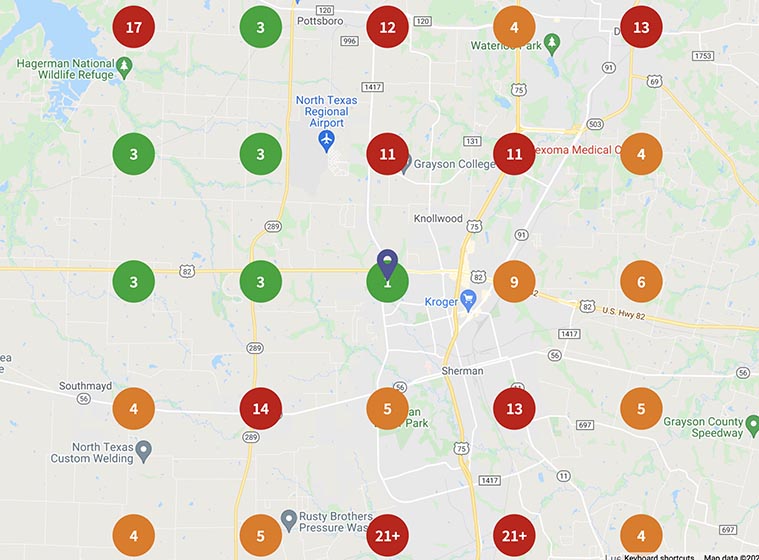
    The screenshot below is a rank grid. Each circle is a spot on the map around Sherman, and the number is where the company showed up in the local pack (the three businesses listed with the map) for a target search made from that spot. Green is top three. Orange is fourth through ninth. Red is tenth or worse. In April 2021 they were top three close to their own location and to the west. Across most of Sherman they were somewhere between ninth and past 21st, which for a local search means invisible.

    Map grid of Sherman, Texas showing the client's Google local pack ranking at each point in April 2021, with most points ranked 4th to 21st or lower
    Local pack rankings across Sherman in April 2021

    Web design and SEO done as one job

    We started with keyword research: what people in their service area typed when they needed this kind of work, and which of those searches had real volume. Then the site and its pages were built around those searches, so each one had a page that answered it.

    The target was the local pack. For a service business that’s the most valuable spot on the results page, because it’s where people tap to call. If the local pack is new to you, our SEO primer for small businesses explains how it works.

    We get asked a lot whether a business needs web design or SEO. In our experience the split is the problem. A good-looking site that doesn’t target any searches is a brochure nobody picks up. A keyword-stuffed site that’s confusing on a phone gets the click and loses the call. You need the design and the search work planned together, from the first page.

    The results

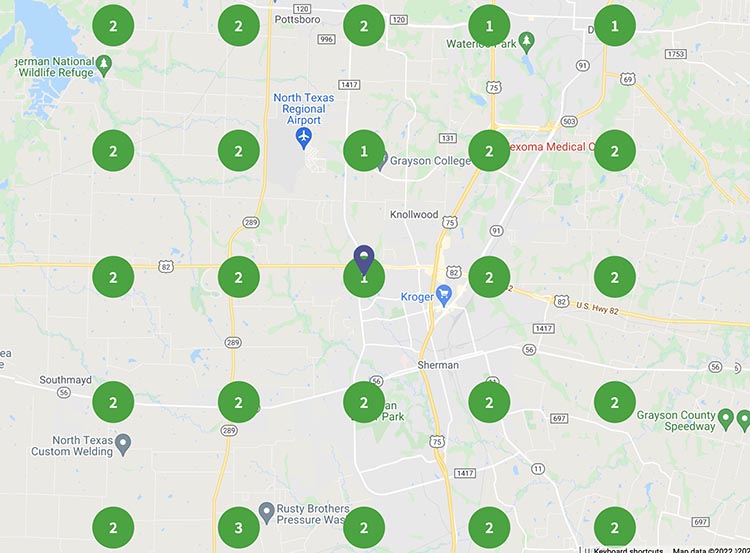
    By January 2022, less than a year after the April 2021 screenshot, the same grid looked like this:

    The same Sherman map grid in January 2022, with the client ranked 1st, 2nd or 3rd at every point
    The same grid in January 2022, less than a year later

    First, second or third at every point on the map. That covers the neighborhoods where they’d been ranking 13th and 21st the spring before.

    Rankings only matter if the phone rings, and it did. The company’s 2021 revenue more than doubled what it had been before they started with us. Marketing wasn’t the only reason. They did good work and answered the phone. But being findable by strangers was the missing piece, and it’s the piece we built.

    Person at a farmhouse kitchen table holding a phone, with a thin red line of light running from it out the window toward a pickup on a gravel road

    What we’d add if we started this project today

    The core of this project still holds up: rank for what customers search, in the places they search from. But local search in 2026 isn’t the same as it was in 2021, and a few things would be on the list from day one.

    The Google Business Profile gets as much attention as the site

    Back then, the website did most of the lifting. Now the Business Profile is often the first thing a customer sees, and sometimes the only thing. They see you in the map results, read a few reviews, and tap call without ever opening your site. Categories, services, photos and hours all feed that listing, so we’d set it up carefully and keep it current. Our Google Business Profile work is its own service for that reason.

    Reviews are part of the plan from month one

    Your review count, your rating and how recently people left reviews all show up right next to your name in the map results. Customers compare them before they call. We’d set up a simple, consistent way to ask every happy customer, starting in the first month instead of waiting until rankings improve. A text with a direct review link, sent the same day the job wraps, works better than any card left on the counter.

    AI answers sit on top of the results

    ChatGPT, Gemini and Google’s AI Overviews now answer a lot of “who should I call” questions directly. Those tools lean on sites and listings that say plainly what a business does and where it works. A site organized around specific services and towns, which is what this one was, has a head start. We’d also make sure the business name, address and phone number match everywhere those tools look.

    It’s all on a phone

    Most people searching for a local service are on a phone, often in a hurry, sometimes standing in a wet kitchen. A tap-to-call button, a page that loads fast on cell data and a contact form you can fill out with one thumb matter more than how the homepage looks on a desktop monitor. We’d design for the phone first and check the desktop second.

    Knowing which searches pay

    We’d track the source of every call and form fill from the start, even if that just means asking each new customer how they found you and writing it in a notebook. Once you know which searches and pages bring in paying work, you know where the next dollar goes. You also find out which pages aren’t pulling their weight, which is just as useful when it’s time to add to the site.

    Try the test we’d run first

    Pick up your phone, open a private browser window, and search for your main service and your town without your business name. Then drive to the other side of town and search again.

    If you’re not in the map results either time, you’re about where this company was in April 2021.

  • SEO for Small Business: How Local Search Works in 2026

    SEO for Small Business: How Local Search Works in 2026

    SEO for small business comes down to one goal: showing up when someone searches for what you do, not who you are. If you own John Doe’s Plumbing, the people who already know your name will find you either way. The customers you’re missing are typing “plumber near me” or “water heater repair Sherman” and picking from whoever Google puts in front of them.

    That part hasn’t changed since we first wrote this post in 2022. A lot around it has. Most local searches happen on a phone now, Google stacks a map and often an AI-written summary above the regular results, and more people ask ChatGPT or Gemini for a recommendation instead of scrolling at all. There are more places to show up, and they don’t all reward the same work.

    Where a local search actually sends people

    Search “pest control Sherman TX” on your phone and look at what comes before the first normal website link. Usually it’s a few sponsored results, sometimes an AI Overview, then a map with three businesses listed under it, and only then the organic results. Each of those is its own contest. A small business can’t win all of them at once, and it doesn’t need to.

    The Google local pack

    The local pack is that map and the three businesses under it. For a plumber, a salon, a dentist or anyone who serves a specific area, it’s the most valuable spot in search, because it’s where people call from. The phone number is right there on the listing.

    Google says local results are mainly based on relevance, distance and prominence. Relevance is how well your Business Profile matches the search. Distance is how far you are from the person searching. Prominence is how established you look online: your reviews and rating, links to your site, mentions around the web.

    Google local pack results for pest control services in Sherman, Texas
    A 2022 screenshot of one of our clients in the top spot of the local pack for pest control in Sherman

    You can’t move your shop, so distance is the one factor you don’t control. It’s also why the pack looks different depending on where the searcher is standing. A business can hold the top spot in downtown Sherman and be nowhere from a kitchen table in Pottsboro.

    We track this with grid-based rank tracking, which checks a client’s map position from dozens of points across their service area instead of from one address. The approach we used back in 2022 still holds: win the ground closest to the business first, then widen the circle town by town until it covers everywhere they work. If you serve both Sherman and Denison and only show up in one, we wrote up why that happens and how to fix it.

    What moves the local pack, in rough order of payoff:

    • A complete Google Business Profile: the right primary category, your actual services, accurate hours, real photos, and a service area that matches where you really go.
    • A steady flow of reviews, with replies. Twenty reviews spread over a year looks healthier than twenty in one week and then silence.
    • A website with pages that match your services and towns, so Google has something substantial to connect the profile to.
    • The same business name, address and phone number everywhere you’re listed.
    Row of fence posts across a flat pasture, with one post circled by a thin ring of red light

    Organic search results

    Below the map sit the regular results. For broad terms they’re much harder to crack. A national chain or a big directory will beat a local pool builder for “pool construction company” every single day. But nobody in Texoma needs to rank nationally. “Pool builder Sherman TX” or “pool construction North Texas” is a far smaller fight, and the person typing it is exactly the customer you want.

    That’s most of keyword strategy for a small business: the specific service plus the specific place, with a real page for each combination that matters. A page for AC repair. A separate one for heat pump installs. A page for Denison if Denison is a big share of your work. One “Services” page with eleven bullet points gives Google almost nothing to rank.

    Phones push this further. Search “Mexican food” on your phone and Google assumes you mean near where you’re standing, so you never type the town. For a lot of searches your site is competing locally whether you planned for it or not. The businesses that told Google clearly what they do and where they do it get the benefit.

    What AI answers changed

    Google’s AI Overviews now show up on plenty of local searches, and people ask ChatGPT, Gemini and Perplexity things like “who’s a good roofer in Denison?” Those tools pull from the same places Google does: your website, your Business Profile, your reviews, directories, local news. A thin site with eight reviews gives them nothing to say about you. It’s the focus of our AI search optimization work, and the short version is that it rewards the same basics, done more thoroughly.

    That means pages that answer the questions customers actually ask (“do you service Bonham?”, “what does a termite inspection involve?”), business details that match everywhere, and reviews that describe the real job instead of just “great service.” None of that is new. There’s just less room now for a business that skipped it.

    Where to start with SEO for small business

    If you’re doing this yourself, go in this order:

    1. Claim and finish your Google Business Profile. Categories, services, hours, photos, service area. It’s an afternoon, not a project.
    2. Ask every happy customer for a review, and text them the link the same day while the job is fresh.
    3. Make sure your website loads fast on a phone and has one page per main service.
    4. Mention the towns you serve on the pages where they belong, in plain sentences. Not a footer stuffed with forty city names.
    5. Open Google Search Console once a month and look at which searches you’re showing up for. It’s free, and it tells you what’s working.

    If you’d rather hand it off, that’s the work our SEO team does every month for local businesses across Texoma. Either way, expect months, not weeks, before it shows in the phone log.

    Most small businesses never get past step two. That’s the opening for the ones that do.