This is one of our earliest web design and SEO projects, for a local service company in the Sherman area that we’re keeping unnamed. We rebuilt their website around what their customers actually search for, and in less than a year they went from buried to Google’s local top three across the city. Their 2021 revenue more than doubled what it had been before they started working with us.
Where they started
Their problem is still the most common one we see. Before we worked together, you couldn’t find this company by searching for what they did. You could find them by searching their name, and that was about it.
A search that includes your business name is a branded search. Those look great in a report because they convert well, but the people doing them already know you from a neighbor or from seeing your truck around town. Branded searches don’t bring in anyone new. The customers a growing business needs are the ones typing the service and the town into Google, who have never heard of you and are about to call whoever shows up first.
Their site wasn’t built for those searches. It didn’t use the words customers used, and it didn’t give Google much reason to show it to anyone who wasn’t already looking for it by name.
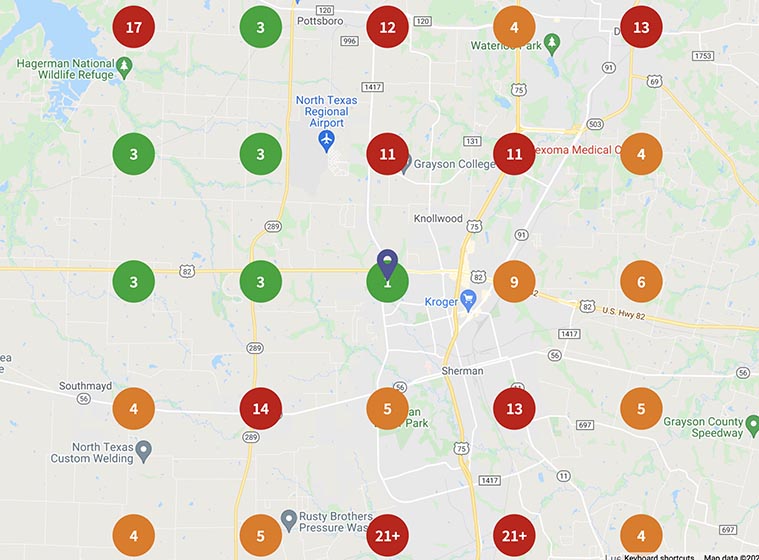
The screenshot below is a rank grid. Each circle is a spot on the map around Sherman, and the number is where the company showed up in the local pack (the three businesses listed with the map) for a target search made from that spot. Green is top three. Orange is fourth through ninth. Red is tenth or worse. In April 2021 they were top three close to their own location and to the west. Across most of Sherman they were somewhere between ninth and past 21st, which for a local search means invisible.
Web design and SEO done as one job
We started with keyword research: what people in their service area typed when they needed this kind of work, and which of those searches had real volume. Then the site and its pages were built around those searches, so each one had a page that answered it.
The target was the local pack. For a service business that’s the most valuable spot on the results page, because it’s where people tap to call. If the local pack is new to you, our SEO primer for small businesses explains how it works.
We get asked a lot whether a business needs web design or SEO. In our experience the split is the problem. A good-looking site that doesn’t target any searches is a brochure nobody picks up. A keyword-stuffed site that’s confusing on a phone gets the click and loses the call. You need the design and the search work planned together, from the first page.
The results
By January 2022, less than a year after the April 2021 screenshot, the same grid looked like this:
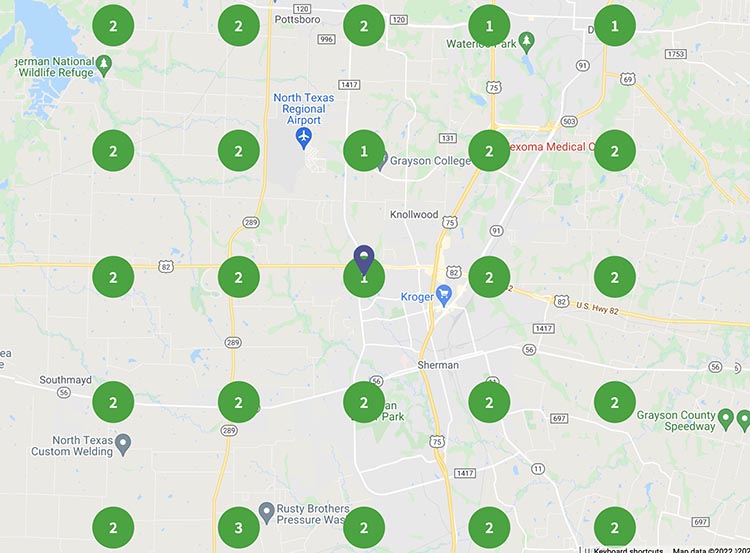
First, second or third at every point on the map. That covers the neighborhoods where they’d been ranking 13th and 21st the spring before.
Rankings only matter if the phone rings, and it did. The company’s 2021 revenue more than doubled what it had been before they started with us. Marketing wasn’t the only reason. They did good work and answered the phone. But being findable by strangers was the missing piece, and it’s the piece we built.

What we’d add if we started this project today
The core of this project still holds up: rank for what customers search, in the places they search from. But local search in 2026 isn’t the same as it was in 2021, and a few things would be on the list from day one.
The Google Business Profile gets as much attention as the site
Back then, the website did most of the lifting. Now the Business Profile is often the first thing a customer sees, and sometimes the only thing. They see you in the map results, read a few reviews, and tap call without ever opening your site. Categories, services, photos and hours all feed that listing, so we’d set it up carefully and keep it current. Our Google Business Profile work is its own service for that reason.
Reviews are part of the plan from month one
Your review count, your rating and how recently people left reviews all show up right next to your name in the map results. Customers compare them before they call. We’d set up a simple, consistent way to ask every happy customer, starting in the first month instead of waiting until rankings improve. A text with a direct review link, sent the same day the job wraps, works better than any card left on the counter.
AI answers sit on top of the results
ChatGPT, Gemini and Google’s AI Overviews now answer a lot of “who should I call” questions directly. Those tools lean on sites and listings that say plainly what a business does and where it works. A site organized around specific services and towns, which is what this one was, has a head start. We’d also make sure the business name, address and phone number match everywhere those tools look.
It’s all on a phone
Most people searching for a local service are on a phone, often in a hurry, sometimes standing in a wet kitchen. A tap-to-call button, a page that loads fast on cell data and a contact form you can fill out with one thumb matter more than how the homepage looks on a desktop monitor. We’d design for the phone first and check the desktop second.
Knowing which searches pay
We’d track the source of every call and form fill from the start, even if that just means asking each new customer how they found you and writing it in a notebook. Once you know which searches and pages bring in paying work, you know where the next dollar goes. You also find out which pages aren’t pulling their weight, which is just as useful when it’s time to add to the site.
Try the test we’d run first
Pick up your phone, open a private browser window, and search for your main service and your town without your business name. Then drive to the other side of town and search again.
If you’re not in the map results either time, you’re about where this company was in April 2021.