

Most lawn care advertising still looks the way it did ten years ago: a stack of door hangers, a magnet on the truck, maybe a Facebook post in March. Those still have a place. But the homeowner in Van Alstyne who needs a mowing service this spring is going to pull out her phone first, and what she finds in the next two minutes decides who gets the call.
Lawn care also has an advantage most businesses don’t. Your customers live next to each other, they look at each other’s yards every day, and every stop you add to a street you already mow is close to pure margin. Good advertising for a lawn business plays to that.
Lawn care advertising should build route density
Before you spend a dollar, get clear on the goal. You don’t want customers scattered across Grayson County. You want ten yards on one street in Sherman instead of ten yards in ten towns. Drive time is the cost that quietly eats lawn companies, and every ad, sign and review request should push toward tighter routes.
That changes how you judge results. A new customer forty minutes out is worth a lot less than one three doors down from your Tuesday stop. Some owners stop quoting outside a set radius during peak season. We think that’s smart.
Your Google Business Profile does the most work
When someone searches “lawn care near me” or “mowing service Denison,” the map results show up before any website. Those listings come from Google Business Profiles, and most lawn companies fill theirs out once and never look at it again.
Go through yours and fix the basics:
- Primary category set to the closest match for what you do (Lawn care service, for most of you), with landscaping or tree work added only if you really do it
- A service area with the towns you actually want to work in. If you run the business out of your house, hide the street address
- Each service listed on its own: mowing, edging, weed control, aeration, leaf cleanup, shrub trimming
- Real photos from real jobs, added through the season instead of all at once
- Hours, and a phone number somebody answers
Google says its local results weigh relevance, distance and prominence, and your reviews feed prominence. A complete profile takes care of relevance. Keeping it current all year is most of what our Google Business Profile management does for service companies.
Reviews close the sale before you ever talk
A homeowner comparing three mowing services looks at the star rating, then at how recent the reviews are. BrightLocal’s 2026 Local Consumer Review Survey found 74% of consumers only care about reviews written in the last three months. A lawn company whose newest review is from two summers ago looks like it went out of business.
So ask all season long, not in one burst in April. The best moment is right after a visit, when the yard looks its best. Text a direct review link that afternoon. Ask them to mention the service and their part of town if they don’t mind. “They’ve mowed our place in Pottsboro every week since April” does more for you than “great job.”
Don’t trade a discount or a free mow for reviews. Google’s rules prohibit incentivized reviews, and it isn’t worth putting the profile at risk.
Then answer every one. The same survey found 80% of consumers are likely to use a business that responds to all of its reviews. Two sentences is plenty. Skip the copy-and-paste reply. People notice.
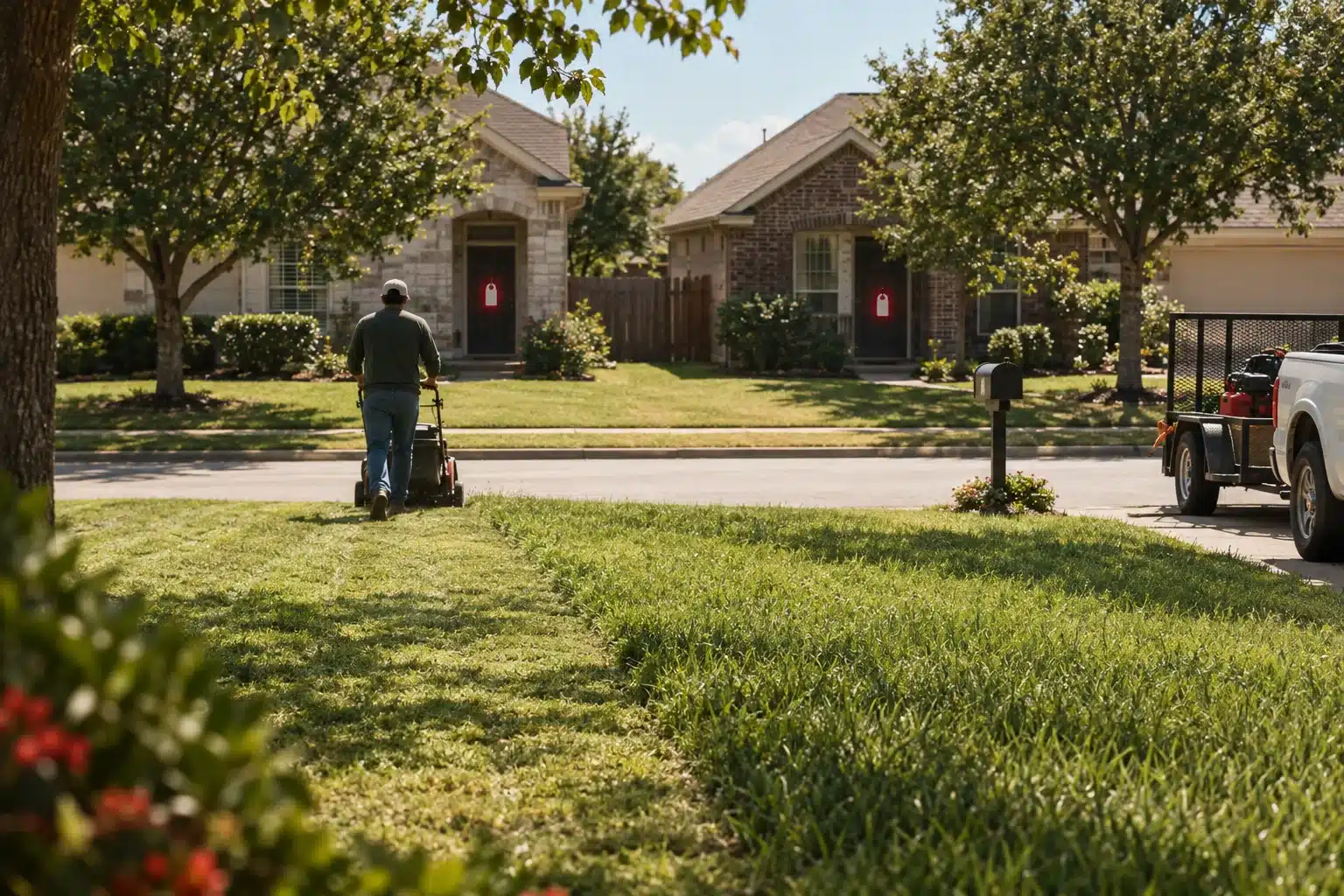
Work the street you’re already on
Your trailer parked on a street is an ad. Treat every job like one.
After a new customer’s first service, hang something on the doors of the houses on either side and across the street. Keep it simple: what you do, that you already mow on their street, and how to get a price. A neighbor who watched you work that morning is about as warm as a lead gets.
A few other things that still pay off:
- Ask happy customers if you can leave a small yard sign for a week after a big cleanup
- Give existing customers a credit for every neighbor who signs up, and write down who referred whom
- Answer the “who do y’all use for mowing?” posts on Nextdoor and in local Facebook groups, and follow each group’s rules on self-promotion
- Keep the truck and trailer clean and lettered with your number
None of this is new. It works because every one of these builds the density you’re after.
Give people a website that answers their questions
Plenty of lawn businesses run on a Facebook page alone. That works until someone wants to know if you cover their town, whether you do one-time mows, or how your pricing works, and the answer isn’t anywhere. We wrote a whole post on why a Facebook page is not a website, and lawn care is a textbook case.
Your site needs a page for each main service, the towns you cover, a plain explanation of how you price (per visit, monthly, or a season contract) and a short quote form. This is one form where asking for the street address makes sense, because you can measure most yards from satellite imagery and send a price without driving out. Customers like getting a number fast, and it saves you a trip.
Cost is usually what holds owners back. Our Website Lease is $500 a month with nothing upfront, so you get a real site without writing a big check in February.
AI answers are a new front door
More homeowners now ask ChatGPT, Gemini or Google’s AI Overviews for a recommendation instead of scrolling a list of results. BrightLocal’s survey found the share of consumers using AI tools for local recommendations went from 6% to 45% in a single year.
Those tools pull from your website, your Google profile, your reviews and directory listings. If your site says “Weekly mowing and seasonal cleanup in Sherman, Denison, Pottsboro and Howe” in plain words, an AI can repeat it. If it says “Your lawn, our passion,” it has nothing to work with. Our AI search optimization work comes down to that: plain, specific facts in the places these tools read.
Paid ads, once the basics are done
Google’s Local Services Ads have a lawn care category. They sit above the regular results and charge per lead instead of per click. Google checks out the business before the ads run and leans on your reviews, so they reward all the groundwork above. Facebook ads can work too, if you draw a tight radius around the neighborhoods you already serve.
Timing matters more than budget. In North Texas people start thinking about their yards in late winter, when the weeds come up and spring signups begin. Ads that start in May are chasing people who already picked someone.
Our honest opinion: don’t pay for ads while your profile has eight reviews and no photos. You’ll be paying for clicks that go look at your competitor.
Keep the customers you already have
The cheapest customer is the one who used you last year. Collect an email and a cell number at every signup. Send a short note in late winter to lock in the new season before anyone else asks them, and one more in fall for leaf cleanup or aeration.
And ask every new caller how they heard about you. Write it down, even on a notepad in the truck. After one season you’ll know which of all this is paying, and you can quit doing the rest.