
Category: Small Business Marketing

  • Texas Instruments: A Texoma Service Business Opportunity

    Texas Instruments: A Texoma Service Business Opportunity

    On December 17, 2025, Texas Instruments started production at SM1, the first of the new chip fabs on its Sherman site, three and a half years after breaking ground in May 2022. TI plans up to four connected fabs there and expects as many as 3,000 direct jobs, plus thousands more at the companies around it. If you fix, clean, cool, mow or spray things for a living, that’s the Texas Instruments Texoma service business opportunity in one sentence: more people, more houses, more calls.

    We’re a little tired of the word “boom,” and a lot of what gets written about it is hype. But the arithmetic here is real, and it’s local. People who take those jobs need somewhere to live, and every one of those houses needs an AC tech, a plumber, a pest guy and somebody to mow the yard.

    Where the Texas Instruments opportunity reaches your service business

    Start with the people who just moved here. They don’t know anybody. They have no plumber, no electrician, no neighbor to ask. They find you the same way everyone new to a town does: a phone, a search box, and whatever shows up first.

    Then there’s the building itself. New subdivisions need everything installed and then maintained. Construction crews on long jobs need services too, and they stay for months. Existing homeowners tend to fix up and upgrade when the area around them is getting busier.

    And it isn’t a single wave. A site with room for four fabs gets built out over years, so demand keeps coming in pieces instead of all at once. That’s good news for a small business that can’t hire ten people in a quarter.

    The competition is coming too

    You aren’t the only one who has noticed. Expect companies based down US-75 in Collin County and Dallas to keep stretching their service areas north. Franchises look at the same growth numbers you do. And some of the local outfits that coasted on word of mouth for twenty years are finally putting money into their marketing.

    Our opinion: the businesses that come out ahead over the next few years won’t necessarily be the biggest or the cheapest. They’ll be the ones a new resident finds first and trusts fastest. A company from McKinney with a sharp Google profile will beat a better local company that’s invisible online, at least until the local one fixes it.

    Unmarked white service pickup in the driveway of a new brick home with fresh sod, with a small red map pin of light above the roof

    Four things to get right this year

    1. Your Google Business Profile

    For most service searches, the map results show up before any website does, and they come from Google Business Profiles. Fill in every field, pick the most specific categories, set your service area to the towns you actually drive to, add real photos, and post something at least every couple of weeks. If you’d rather hand it off, that’s what our Google Business Profile management covers.

    2. A website that shows up in more than one town

    Newcomers are landing all over the region, from Sherman and Denison to Van Alstyne, Howe and Pottsboro. A lot of businesses rank fine in their home town and disappear two exits down the highway. Usually the fix is a real page for each town you serve, with your actual work there, and a site that loads fast on a phone. We walked through it in why you rank in Sherman but not Denison.

    3. Reviews, on purpose

    A new resident has nothing to go on but your star rating and what strangers wrote about you. Ask every customer for a Google review with a direct link, and answer every review you get. It’s the cheapest marketing on this list and the one owners skip most.

    4. Answer the phone, and know where calls come from

    More visibility means more inquiries, and it means nothing if half of them go to voicemail and never get a call back. People with a broken water heater call the next name on the list. Our post on why whoever answers first wins the job goes deeper on that.

    Keep a simple lead log while you’re at it, even a spreadsheet: date, name, what they needed, how they found you, whether you booked it. After three months you’ll know which of the other three things is paying off.

    What we’d do if we owned a service company here

    We’d do the free stuff first. The Google Business Profile and a review routine cost nothing but time, and they’re where a new resident’s search starts. Then we’d fix the website, especially the service-area pages. Ads come last, once the profile and site are good enough that the clicks we pay for actually turn into calls.

    SM1 is already running, and TI’s own plans leave room for three more fabs on the same site. Whatever the pace of the rest of it, the people are already arriving, and they’re searching for someone to call.

  • RV Resort Digital Marketing Case Study: Sunset View

    RV Resort Digital Marketing Case Study: Sunset View

    Sunset View RV Resort is a few minutes from Lake Texoma in Kingston, Oklahoma. It has a pool, a pickleball court, a stocked fishing pond, a dog park and monthly sites, and it’s a short drive from several casinos. In other words, a good park that deserved more guests than it was getting from search. The owners handed us their website and search in October 2025. This RV resort digital marketing case study covers what we changed and what happened through the first half of 2026.

    The short version: booking revenue for January through June 2026 doubled compared with the same months of 2025.

    What we measuredResult
    Booking revenue, Jan-Jun 2026 vs. the same months of 20252x
    Clicks from Google search, Jan-Jun 20262.6x
    Times the resort appears in Google search40,000+ a month

    Where the resort started

    Plenty of guests found Sunset View the old-fashioned way. They drove past it, or somebody at the lake mentioned it. That works fine in July.

    It works a lot less in January. The weekend crowd thins out and a lake park lives on people who plan ahead: snowbirds, monthly guests, work crews on long jobs, couples booking a casino weekend. Those guests search before they drive. When they searched, the resort didn’t show up the way a park with its amenities should have, and the old website didn’t make a strong case once they got there. It didn’t clearly say what the park offered, who it was built for, or how to book from a phone.

    What we did

    Nothing exotic. Most of this is the same work any local business needs. It just had to fit the way RV travelers shop, which is on a phone, comparing three or four parks, often from the cab of a truck.

    A new website built around how guests book

    We rebuilt the site from the ground up. Different guests get pages that answer their own questions: weekend visitors, long-term and monthly stays, and crews who need a place to park near a job site. Amenities, rules, directions and things to do nearby sit where people expect them, and booking is one tap away on any page. That’s the approach behind every website we design: figure out who is actually searching, then give each of them a page.

    Local search

    We rewrote titles and page copy around the searches travelers really run, like RV parks near the lake, near the casinos, and monthly RV sites in the area, and built the new site so Google could read it cleanly: fast pages, clear headings, one topic per page. This is the slow, unglamorous part of local SEO. It’s also the part that compounds.

    Campground office counter with a paper site map, keys and a phone, and a small red map pin of light hovering over the map

    Google Business Profile and reviews

    For a campground, the map listing does a lot of the selling before anyone reaches the website. People see the photos, the star rating and the most recent reviews, and a lot of them decide right there. We cleaned up the resort’s Google Business Profile: categories, amenities, hours, current photos and regular posts. We also set up a routine for asking guests for reviews and answering the ones that come in, good or bad.

    If you want to do the profile work yourself, our guide to optimizing a Google Business Profile in 2026 walks through it field by field.

    The results

    Search moved first. Clicks from Google search grew 2.6x over January through June 2026, and the resort now shows up in Google more than 40,000 times a month. Those are people looking for a place to stay around Lake Texoma and seeing Sunset View in the results.

    Revenue is the number the owners care about, and it followed. Booking revenue for January through June 2026 was double what the same six months brought in during 2025. Those months include the slowest stretch of the year for a lake park, the same stretch where drive-by traffic used to dry up.

    What an RV resort digital marketing case study can and can’t tell you

    We’d be suspicious of any agency that took credit for every dollar of a doubling. Rates change. Weather changes. One rainy spring can wreck a season for everybody on the lake. What we can say is that far more people found the resort on Google, they landed on a site that made booking easy, and revenue rose over the same months.

    When you read any agency’s case study, ours included, check when the work started, what the comparison period is, and whether the results are the ones the owner would actually put on a bank deposit slip. Rankings for a handful of hand-picked keywords are nice. Revenue against the same months last year is better.

    What carries over to other seasonal businesses

    If you run anything seasonal around Lake Texoma, like a marina, a boat rental, cabins, an event venue or a guide service, the slow months are where marketing earns its keep. Summer customers find you anyway. Off-season customers plan, and planners search.

    • Give each type of off-season customer its own page. A monthly guest and a weekend guest ask completely different questions.
    • Keep your Google Business Profile current all year, with hours and photos that match the season.
    • Ask for reviews during your busy months, so the profile still looks active when things are quiet.
    • Watch search clicks and calls month over month. You’ll see which months need a push before the bank balance tells you.

    None of that requires a big budget. It does require somebody to keep doing it after the first month, which is usually where seasonal businesses fall off.

  • Social Media Management for Local Businesses: What Works

    Social Media Management for Local Businesses: What Works

    Most owners we talk to in Sherman and Denison have a love-hate thing going with social media. They know their customers are on it. They also know a Facebook page whose last post went up in 2023 looks worse than having no page at all. Good social media management fixes that second problem without eating your evenings.

    The audience hasn’t gone anywhere. In Pew Research Center’s 2025 survey of U.S. adults, 84% said they use YouTube, 71% Facebook and 50% Instagram. So the people who need a plumber in Pottsboro or a stylist in Gainesville are scrolling the same feeds as everyone else. What matters is whether you show up there looking open for business.

    What social media management actually includes

    Posting is the part everyone pictures, and it’s maybe a third of the job. The rest is answering comments and messages, keeping hours and contact details right on every profile, keeping an eye on reviews and recommendations on Facebook, and checking once a month whether any of it turned into calls.

    If you only do the posting, you’ve put up a billboard nobody can talk to. People message businesses on Facebook and Instagram the way they used to pick up the phone. An unread message from a homeowner with a leaking water heater is a lost job, same as a missed call.

    Pick two platforms and keep them current

    You don’t need to be everywhere. For most Texoma service businesses, Facebook matters most. It’s where the neighborhood groups and the “who do y’all use for gutters?” threads live, and it’s where a lot of homeowners over 40 still spend their scrolling time. Instagram comes second if your work photographs well: landscaping, remodels, hair, food, detailing.

    Add YouTube or TikTok when you’re ready to make short videos, and not before. A dead TikTok account helps nobody. If you’re weighing it, we wrote a separate piece on short-form video for local businesses.

    Two accounts kept up beat five that went quiet in March.

    Post the things a franchise can’t

    The posts that do well for local businesses tend to be the plain ones. A photo of today’s job. The crew loading the trailer at 7 a.m. A backyard in Van Alstyne before and after. A 30-second answer to a question customers ask every week. Some ideas that hold up:

    • Finished work, with the town named in the caption
    • Your people, by first name
    • Seasonal reminders that help someone, like an AC check before the first 100-degree week or a pipe warning before a hard freeze
    • Answers to the questions you hear on every estimate
    • Local things you’re part of: the ball team you sponsor, the fundraiser at church, the booth at the county fair

    Skip the stock photos and the “Happy National Donut Day” graphics. People scroll right past them, and they make your page look like every other page. Meta Business Suite lets you schedule Facebook and Instagram posts for free, so you can batch a month of posts on a slow Tuesday afternoon and be done with it.

    Phone in a pickup truck dash mount showing message bubbles, a gloved hand reaching for it, with a house blurred through the windshield.

    Reply like it’s a phone call

    This is where most business pages fall apart. Someone comments “Do you service Bonham?” and it sits for four days. By then they’ve hired someone else.

    Make it a rule that comments and messages get answered the same business day. Turn on page notifications on one phone that somebody actually checks. Saved replies in Meta Business Suite handle the questions you get constantly (hours, service area, how to get a quote), and a personal line on top keeps them from sounding canned.

    Speed matters more than polish. We made the case in our piece on lead response time: the business that answers first usually gets the job, and a Facebook message is no different from a phone call.

    Negative comments get a reply too. Keep it public, calm and short, and offer to sort it out by phone. Deleting a complaint usually makes the person louder.

    Count calls, not likes

    Every platform will hand you reach and engagement numbers. They’re useful for seeing which posts people liked. They won’t tell you whether the phone rang.

    Some low-tech ways to tie social media to real customers:

    • Ask every new caller how they heard about you and write it down. A spreadsheet is fine.
    • When you share your website in a post, use a tagged link (a UTM link) so Google Analytics can show which visits came from Facebook.
    • Track message volume month to month. For some local businesses, Messenger brings in more leads than the website form does, and you won’t know until you count.
    • Open your page insights once a month. Not once an hour.

    If you’d rather have that tracked for you, our reporting shows who visited your site, how they found you and who called.

    Doing social media management yourself or hiring it out

    Plenty of owners run their own pages well. If you enjoy it, can find 45 minutes a week and take a decent photo on your phone, do it yourself. You know your customers better than any agency does.

    Hiring it out makes sense when the page goes dark every busy season, when nobody on staff owns the messages, or when you want steady posting and some video but don’t have the hours. Know the tradeoff going in. An outside manager needs your job photos, your stories and your quick answers to sound like you, and a good one will keep asking for them. If they never ask, you’ll get generic posts. If you’d rather hand it off, here’s how our social media management service works.

  • Web Design for Local Business: The 2 Things Most Sites Miss

    Web Design for Local Business: The 2 Things Most Sites Miss

    When a pipe bursts at 9 p.m. in Denison, nobody drives around looking for a plumber. They grab a phone, search, tap the first business that looks legit, and call. Good web design for local business is built around that moment, and most of the sites we look at in Texoma aren’t.

    They’re not ugly. Plenty of them look fine on the monitor in the office. The trouble is they fail at the two jobs that matter most for a local company: working on a phone, and helping Google (and now AI search tools) understand what you do and where you do it. Get those two right and most of the other decisions get easier.

    Secret one: design for the phone first

    We still see owners approve a new site by looking at it on a laptop. Your customers mostly aren’t on a laptop. They’re in a truck, a parking lot or a kitchen with a phone in one hand, and they want three answers fast. Do you do this? Do you work in my area? How do I reach you?

    Mobile-friendly in 2026 means more than shrinking the desktop version until it fits. These are the things we check first on a phone:

    • The phone number is tappable, visible without scrolling, and rings the right line.
    • The page loads in a couple of seconds on a normal cell signal, not just office Wi-Fi. Huge uncompressed photos are the usual culprit.
    • Buttons are big enough for a thumb.
    • Forms are short. Name, phone, what you need. Every extra field costs you leads.
    • Nothing pops up and covers the screen the second the page opens.
    • Your service area is stated in plain words near the top, something like “Serving Sherman, Denison, Pottsboro and Van Alstyne.”

    There’s a search reason for this too. Google crawls and indexes the mobile version of your site. If a paragraph or a whole page only shows up on desktop, as far as Google is concerned it isn’t there.

    Try this tonight. Pull up your own site on your phone, turn off Wi-Fi, and see if you can start a call to your business in under ten seconds. If you can’t, neither can a customer standing in two inches of water. And that customer isn’t going to try twice. The next listing is one thumb-scroll away.

    A hand holding a phone at a farmhouse kitchen table with a small glowing red map pin floating above it

    Secret two: web design for local business has to win local search

    The second miss is treating the website and your local search presence as two separate projects. They feed each other. When someone searches “roof repair near me,” Google leans heavily on your Google Business Profile for the map results, and it looks at your website to confirm what the profile says. ChatGPT, Gemini and Google’s AI Overviews work in a similar way when they recommend a local company. They pull from pages that say plainly what a business does and where. We dig into that side in how to get found in AI search.

    Four things make the biggest difference.

    A real page for each service and each main town

    One “Services” page that lists twelve things won’t rank for any of them. A page for water heater repair, another for drain cleaning, and pages for the towns you actually cover give search engines something specific to match. Write them for people: what the job involves, what to expect, which areas you serve. Copying the same paragraph six times with a different city name swapped in doesn’t count, and Google is good at spotting it.

    The same name, address and phone everywhere

    Your business name, address and phone number should read the same on your site, your Google Business Profile, Facebook, Yelp and any directory that lists you. “Suite 4” on one and “#4” on another is minor. An old phone number on half your listings isn’t. When the details disagree, Google has a harder time trusting any of them.

    A site and profile that tell the same story

    Your profile should link to the most relevant page on your site, usually the homepage or a location page. The site should match the profile on hours, services and service area. Keep the profile alive with fresh photos and replies to reviews. Our guide to optimizing your Google Business Profile walks through the settings that matter.

    Reviews where people make the decision

    People read reviews before they call. A few real ones on each service page, with the customer’s first name and town, answer the trust question right where someone is deciding. Use actual reviews you can point to. Made-up testimonials are easy to spot and they sink the whole page.

    What matters less than you’d think

    Owners tend to spend their energy on colors, fonts and whether the logo should be bigger. Those matter some. A clean, current look tells a visitor you’re still in business and take the work seriously. But we’ve never watched a local company lose calls because the blue was the wrong blue. We’ve watched plenty lose calls because the phone number was buried in the footer.

    A few things do earn their keep: real photos of your crew and your work instead of stock images, the padlock in the browser bar (an SSL certificate), and some way to tell where leads come from. If you can’t say whether this month’s calls came from Google, Facebook or the sign on your truck, you’re guessing about what works. Even a simple log by the phone beats nothing.

    A five-minute check of your local business website

    1. Open the site on your phone. Can you call in one tap from the top of the page?
    2. Search your main service plus your town. Do you show up in the map results, and does your website show up below them?
    3. Compare the hours and phone number on your site and your Google profile. Do they match?
    4. Count your service pages. Does each main job you do have its own?
    5. Ask ChatGPT or Gemini who does your kind of work in your town. Are you in the answer?

    Missing two or more usually means the site is costing you work. Some of these are quick fixes. Others mean the site sits on a template that was never built for a local company, and a rebuild designed around local search is cheaper over time than patching it. If the upfront cost is what’s holding you back, our website lease is $500 a month with nothing upfront, and it covers the build and the upkeep.

    Either way, start with the phone test. It takes a minute and it tells you most of what you need to know.

  • Lawn Care Advertising: How to Fill Your Route in 2026

    Lawn Care Advertising: How to Fill Your Route in 2026

    Most lawn care advertising still looks the way it did ten years ago: a stack of door hangers, a magnet on the truck, maybe a Facebook post in March. Those still have a place. But the homeowner in Van Alstyne who needs a mowing service this spring is going to pull out her phone first, and what she finds in the next two minutes decides who gets the call.

    Lawn care also has an advantage most businesses don’t. Your customers live next to each other, they look at each other’s yards every day, and every stop you add to a street you already mow is close to pure margin. Good advertising for a lawn business plays to that.

    Lawn care advertising should build route density

    Before you spend a dollar, get clear on the goal. You don’t want customers scattered across Grayson County. You want ten yards on one street in Sherman instead of ten yards in ten towns. Drive time is the cost that quietly eats lawn companies, and every ad, sign and review request should push toward tighter routes.

    That changes how you judge results. A new customer forty minutes out is worth a lot less than one three doors down from your Tuesday stop. Some owners stop quoting outside a set radius during peak season. We think that’s smart.

    Your Google Business Profile does the most work

    When someone searches “lawn care near me” or “mowing service Denison,” the map results show up before any website. Those listings come from Google Business Profiles, and most lawn companies fill theirs out once and never look at it again.

    Go through yours and fix the basics:

    • Primary category set to the closest match for what you do (Lawn care service, for most of you), with landscaping or tree work added only if you really do it
    • A service area with the towns you actually want to work in. If you run the business out of your house, hide the street address
    • Each service listed on its own: mowing, edging, weed control, aeration, leaf cleanup, shrub trimming
    • Real photos from real jobs, added through the season instead of all at once
    • Hours, and a phone number somebody answers

    Google says its local results weigh relevance, distance and prominence, and your reviews feed prominence. A complete profile takes care of relevance. Keeping it current all year is most of what our Google Business Profile management does for service companies.

    Reviews close the sale before you ever talk

    A homeowner comparing three mowing services looks at the star rating, then at how recent the reviews are. BrightLocal’s 2026 Local Consumer Review Survey found 74% of consumers only care about reviews written in the last three months. A lawn company whose newest review is from two summers ago looks like it went out of business.

    So ask all season long, not in one burst in April. The best moment is right after a visit, when the yard looks its best. Text a direct review link that afternoon. Ask them to mention the service and their part of town if they don’t mind. “They’ve mowed our place in Pottsboro every week since April” does more for you than “great job.”

    Don’t trade a discount or a free mow for reviews. Google’s rules prohibit incentivized reviews, and it isn’t worth putting the profile at risk.

    Then answer every one. The same survey found 80% of consumers are likely to use a business that responds to all of its reviews. Two sentences is plenty. Skip the copy-and-paste reply. People notice.

    A lawn care worker mowing a front yard at midday while blank door hangers hang on the neighboring houses' front doors.

    Work the street you’re already on

    Your trailer parked on a street is an ad. Treat every job like one.

    After a new customer’s first service, hang something on the doors of the houses on either side and across the street. Keep it simple: what you do, that you already mow on their street, and how to get a price. A neighbor who watched you work that morning is about as warm as a lead gets.

    A few other things that still pay off:

    • Ask happy customers if you can leave a small yard sign for a week after a big cleanup
    • Give existing customers a credit for every neighbor who signs up, and write down who referred whom
    • Answer the “who do y’all use for mowing?” posts on Nextdoor and in local Facebook groups, and follow each group’s rules on self-promotion
    • Keep the truck and trailer clean and lettered with your number

    None of this is new. It works because every one of these builds the density you’re after.

    Give people a website that answers their questions

    Plenty of lawn businesses run on a Facebook page alone. That works until someone wants to know if you cover their town, whether you do one-time mows, or how your pricing works, and the answer isn’t anywhere. We wrote a whole post on why a Facebook page is not a website, and lawn care is a textbook case.

    Your site needs a page for each main service, the towns you cover, a plain explanation of how you price (per visit, monthly, or a season contract) and a short quote form. This is one form where asking for the street address makes sense, because you can measure most yards from satellite imagery and send a price without driving out. Customers like getting a number fast, and it saves you a trip.

    Cost is usually what holds owners back. Our Website Lease is $500 a month with nothing upfront, so you get a real site without writing a big check in February.

    AI answers are a new front door

    More homeowners now ask ChatGPT, Gemini or Google’s AI Overviews for a recommendation instead of scrolling a list of results. BrightLocal’s survey found the share of consumers using AI tools for local recommendations went from 6% to 45% in a single year.

    Those tools pull from your website, your Google profile, your reviews and directory listings. If your site says “Weekly mowing and seasonal cleanup in Sherman, Denison, Pottsboro and Howe” in plain words, an AI can repeat it. If it says “Your lawn, our passion,” it has nothing to work with. Our AI search optimization work comes down to that: plain, specific facts in the places these tools read.

    Paid ads, once the basics are done

    Google’s Local Services Ads have a lawn care category. They sit above the regular results and charge per lead instead of per click. Google checks out the business before the ads run and leans on your reviews, so they reward all the groundwork above. Facebook ads can work too, if you draw a tight radius around the neighborhoods you already serve.

    Timing matters more than budget. In North Texas people start thinking about their yards in late winter, when the weeds come up and spring signups begin. Ads that start in May are chasing people who already picked someone.

    Our honest opinion: don’t pay for ads while your profile has eight reviews and no photos. You’ll be paying for clicks that go look at your competitor.

    Keep the customers you already have

    The cheapest customer is the one who used you last year. Collect an email and a cell number at every signup. Send a short note in late winter to lock in the new season before anyone else asks them, and one more in fall for leaf cleanup or aeration.

    And ask every new caller how they heard about you. Write it down, even on a notepad in the truck. After one season you’ll know which of all this is paying, and you can quit doing the rest.

  • Case Study: Web Design and SEO for a Local Business

    Case Study: Web Design and SEO for a Local Business

    This is one of our earliest web design and SEO projects, for a local service company in the Sherman area that we’re keeping unnamed. We rebuilt their website around what their customers actually search for, and in less than a year they went from buried to Google’s local top three across the city. Their 2021 revenue more than doubled what it had been before they started working with us.

    Where they started

    Their problem is still the most common one we see. Before we worked together, you couldn’t find this company by searching for what they did. You could find them by searching their name, and that was about it.

    A search that includes your business name is a branded search. Those look great in a report because they convert well, but the people doing them already know you from a neighbor or from seeing your truck around town. Branded searches don’t bring in anyone new. The customers a growing business needs are the ones typing the service and the town into Google, who have never heard of you and are about to call whoever shows up first.

    Their site wasn’t built for those searches. It didn’t use the words customers used, and it didn’t give Google much reason to show it to anyone who wasn’t already looking for it by name.

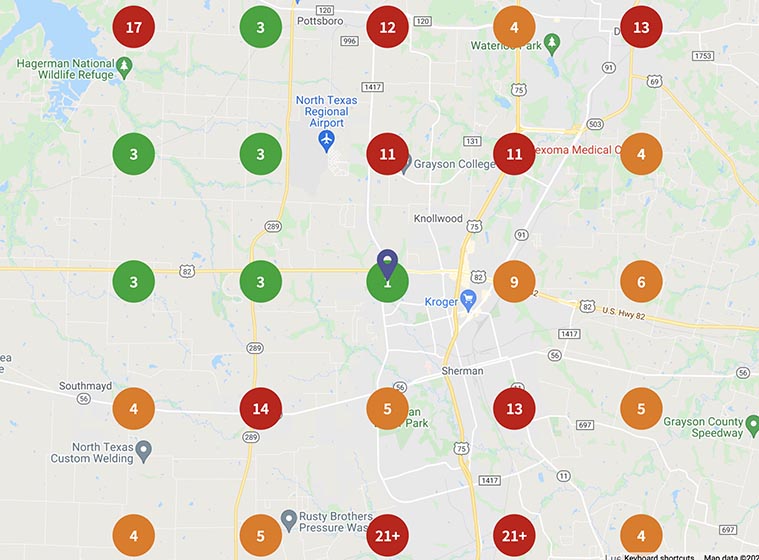
    The screenshot below is a rank grid. Each circle is a spot on the map around Sherman, and the number is where the company showed up in the local pack (the three businesses listed with the map) for a target search made from that spot. Green is top three. Orange is fourth through ninth. Red is tenth or worse. In April 2021 they were top three close to their own location and to the west. Across most of Sherman they were somewhere between ninth and past 21st, which for a local search means invisible.

    Map grid of Sherman, Texas showing the client's Google local pack ranking at each point in April 2021, with most points ranked 4th to 21st or lower
    Local pack rankings across Sherman in April 2021

    Web design and SEO done as one job

    We started with keyword research: what people in their service area typed when they needed this kind of work, and which of those searches had real volume. Then the site and its pages were built around those searches, so each one had a page that answered it.

    The target was the local pack. For a service business that’s the most valuable spot on the results page, because it’s where people tap to call. If the local pack is new to you, our SEO primer for small businesses explains how it works.

    We get asked a lot whether a business needs web design or SEO. In our experience the split is the problem. A good-looking site that doesn’t target any searches is a brochure nobody picks up. A keyword-stuffed site that’s confusing on a phone gets the click and loses the call. You need the design and the search work planned together, from the first page.

    The results

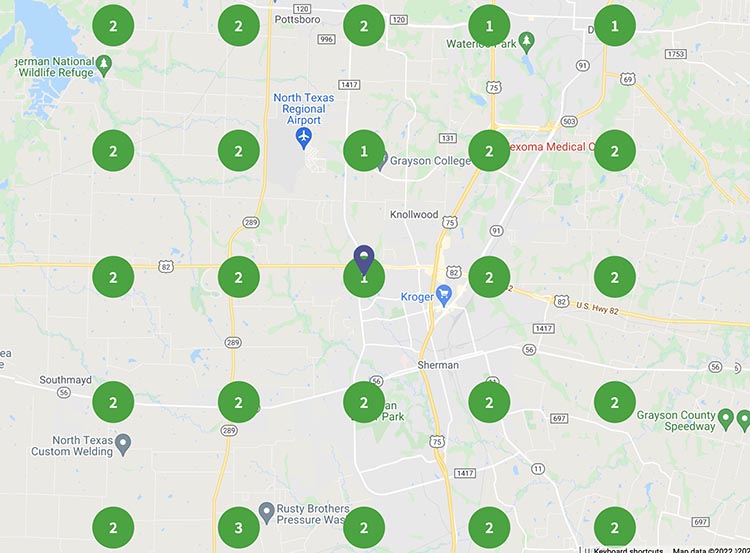
    By January 2022, less than a year after the April 2021 screenshot, the same grid looked like this:

    The same Sherman map grid in January 2022, with the client ranked 1st, 2nd or 3rd at every point
    The same grid in January 2022, less than a year later

    First, second or third at every point on the map. That covers the neighborhoods where they’d been ranking 13th and 21st the spring before.

    Rankings only matter if the phone rings, and it did. The company’s 2021 revenue more than doubled what it had been before they started with us. Marketing wasn’t the only reason. They did good work and answered the phone. But being findable by strangers was the missing piece, and it’s the piece we built.

    Person at a farmhouse kitchen table holding a phone, with a thin red line of light running from it out the window toward a pickup on a gravel road

    What we’d add if we started this project today

    The core of this project still holds up: rank for what customers search, in the places they search from. But local search in 2026 isn’t the same as it was in 2021, and a few things would be on the list from day one.

    The Google Business Profile gets as much attention as the site

    Back then, the website did most of the lifting. Now the Business Profile is often the first thing a customer sees, and sometimes the only thing. They see you in the map results, read a few reviews, and tap call without ever opening your site. Categories, services, photos and hours all feed that listing, so we’d set it up carefully and keep it current. Our Google Business Profile work is its own service for that reason.

    Reviews are part of the plan from month one

    Your review count, your rating and how recently people left reviews all show up right next to your name in the map results. Customers compare them before they call. We’d set up a simple, consistent way to ask every happy customer, starting in the first month instead of waiting until rankings improve. A text with a direct review link, sent the same day the job wraps, works better than any card left on the counter.

    AI answers sit on top of the results

    ChatGPT, Gemini and Google’s AI Overviews now answer a lot of “who should I call” questions directly. Those tools lean on sites and listings that say plainly what a business does and where it works. A site organized around specific services and towns, which is what this one was, has a head start. We’d also make sure the business name, address and phone number match everywhere those tools look.

    It’s all on a phone

    Most people searching for a local service are on a phone, often in a hurry, sometimes standing in a wet kitchen. A tap-to-call button, a page that loads fast on cell data and a contact form you can fill out with one thumb matter more than how the homepage looks on a desktop monitor. We’d design for the phone first and check the desktop second.

    Knowing which searches pay

    We’d track the source of every call and form fill from the start, even if that just means asking each new customer how they found you and writing it in a notebook. Once you know which searches and pages bring in paying work, you know where the next dollar goes. You also find out which pages aren’t pulling their weight, which is just as useful when it’s time to add to the site.

    Try the test we’d run first

    Pick up your phone, open a private browser window, and search for your main service and your town without your business name. Then drive to the other side of town and search again.

    If you’re not in the map results either time, you’re about where this company was in April 2021.

  • SEO for Small Business: How Local Search Works in 2026

    SEO for Small Business: How Local Search Works in 2026

    SEO for small business comes down to one goal: showing up when someone searches for what you do, not who you are. If you own John Doe’s Plumbing, the people who already know your name will find you either way. The customers you’re missing are typing “plumber near me” or “water heater repair Sherman” and picking from whoever Google puts in front of them.

    That part hasn’t changed since we first wrote this post in 2022. A lot around it has. Most local searches happen on a phone now, Google stacks a map and often an AI-written summary above the regular results, and more people ask ChatGPT or Gemini for a recommendation instead of scrolling at all. There are more places to show up, and they don’t all reward the same work.

    Where a local search actually sends people

    Search “pest control Sherman TX” on your phone and look at what comes before the first normal website link. Usually it’s a few sponsored results, sometimes an AI Overview, then a map with three businesses listed under it, and only then the organic results. Each of those is its own contest. A small business can’t win all of them at once, and it doesn’t need to.

    The Google local pack

    The local pack is that map and the three businesses under it. For a plumber, a salon, a dentist or anyone who serves a specific area, it’s the most valuable spot in search, because it’s where people call from. The phone number is right there on the listing.

    Google says local results are mainly based on relevance, distance and prominence. Relevance is how well your Business Profile matches the search. Distance is how far you are from the person searching. Prominence is how established you look online: your reviews and rating, links to your site, mentions around the web.

    Google local pack results for pest control services in Sherman, Texas
    A 2022 screenshot of one of our clients in the top spot of the local pack for pest control in Sherman

    You can’t move your shop, so distance is the one factor you don’t control. It’s also why the pack looks different depending on where the searcher is standing. A business can hold the top spot in downtown Sherman and be nowhere from a kitchen table in Pottsboro.

    We track this with grid-based rank tracking, which checks a client’s map position from dozens of points across their service area instead of from one address. The approach we used back in 2022 still holds: win the ground closest to the business first, then widen the circle town by town until it covers everywhere they work. If you serve both Sherman and Denison and only show up in one, we wrote up why that happens and how to fix it.

    What moves the local pack, in rough order of payoff:

    • A complete Google Business Profile: the right primary category, your actual services, accurate hours, real photos, and a service area that matches where you really go.
    • A steady flow of reviews, with replies. Twenty reviews spread over a year looks healthier than twenty in one week and then silence.
    • A website with pages that match your services and towns, so Google has something substantial to connect the profile to.
    • The same business name, address and phone number everywhere you’re listed.
    Row of fence posts across a flat pasture, with one post circled by a thin ring of red light

    Organic search results

    Below the map sit the regular results. For broad terms they’re much harder to crack. A national chain or a big directory will beat a local pool builder for “pool construction company” every single day. But nobody in Texoma needs to rank nationally. “Pool builder Sherman TX” or “pool construction North Texas” is a far smaller fight, and the person typing it is exactly the customer you want.

    That’s most of keyword strategy for a small business: the specific service plus the specific place, with a real page for each combination that matters. A page for AC repair. A separate one for heat pump installs. A page for Denison if Denison is a big share of your work. One “Services” page with eleven bullet points gives Google almost nothing to rank.

    Phones push this further. Search “Mexican food” on your phone and Google assumes you mean near where you’re standing, so you never type the town. For a lot of searches your site is competing locally whether you planned for it or not. The businesses that told Google clearly what they do and where they do it get the benefit.

    What AI answers changed

    Google’s AI Overviews now show up on plenty of local searches, and people ask ChatGPT, Gemini and Perplexity things like “who’s a good roofer in Denison?” Those tools pull from the same places Google does: your website, your Business Profile, your reviews, directories, local news. A thin site with eight reviews gives them nothing to say about you. It’s the focus of our AI search optimization work, and the short version is that it rewards the same basics, done more thoroughly.

    That means pages that answer the questions customers actually ask (“do you service Bonham?”, “what does a termite inspection involve?”), business details that match everywhere, and reviews that describe the real job instead of just “great service.” None of that is new. There’s just less room now for a business that skipped it.

    Where to start with SEO for small business

    If you’re doing this yourself, go in this order:

    1. Claim and finish your Google Business Profile. Categories, services, hours, photos, service area. It’s an afternoon, not a project.
    2. Ask every happy customer for a review, and text them the link the same day while the job is fresh.
    3. Make sure your website loads fast on a phone and has one page per main service.
    4. Mention the towns you serve on the pages where they belong, in plain sentences. Not a footer stuffed with forty city names.
    5. Open Google Search Console once a month and look at which searches you’re showing up for. It’s free, and it tells you what’s working.

    If you’d rather hand it off, that’s the work our SEO team does every month for local businesses across Texoma. Either way, expect months, not weeks, before it shows in the phone log.

    Most small businesses never get past step two. That’s the opening for the ones that do.