
Category: Social Media

  • Why Your Followers Aren’t Becoming Social Media Customers

    Why Your Followers Aren’t Becoming Social Media Customers

    Picture a Sherman remodeler with almost four thousand Facebook followers who can’t name a single job that came from them. He posts every week. People like the photos. His daughter cuts Reels for him. The phone doesn’t ring because of any of it. We hear some version of this a lot, and the owner nearly always blames the content. Usually the content is fine. What’s missing is a path from “nice work” to “can you come look at my kitchen,” and that path is how followers become social media customers.

    Likes don’t pay the bills. Here are the five places the path usually breaks, in the order we’d fix them.

    Your profile doesn’t say what you do or where

    Open your own Facebook or Instagram page on your phone and read it like a stranger would. Can you tell in three seconds what the business does and which towns it covers?

    Most local bios can’t pass that test. They say something like “Family owned since 2011. Faith. Family. Hustle. DM for info.” That’s a personality. Somebody who found you through a friend’s share still has no idea if you work in Denison, whether you take commercial jobs, or how to hire you.

    The fix takes about four minutes. Say what you do, where you do it, and what the next step is: “Residential electrical. Sherman, Denison and Grayson County. Free estimates, tap below to book.” Boring beats clever here. Boring gets called.

    While you’re in there, fill out the profile fields too: address or service area, hours, phone, category. Both platforms use them for local discovery, and plenty of Texoma businesses leave them blank.

    Your link goes nowhere useful

    Most local businesses point the bio link at the homepage. Someone who just watched a minute-long video about a bathroom remodel lands on a big photo, a mission statement, six service categories and no obvious next step. They leave.

    Interest goes stale fast. Send the link to the one thing you want people to do: a quote form, a booking calendar, or the page for the service you’ve been posting about. If you use a link-in-bio tool, keep it to three choices, not twelve.

    That page has to load fast on a phone, and the form should be short. Name, phone, what they need. Asking for a mailing address to book a free estimate is a good way to lose someone who was ready to hire you.

    A phone lying on a cluttered workshop bench among tools, its screen glowing with a small red light while no one is around.

    You take hours to answer a DM

    This one costs the most jobs. For a lot of people, especially younger homeowners who would rather type than call, a Facebook message or an Instagram DM is now the normal way to reach a local business.

    The trouble is that messages land in an app nobody on the team owns. They sit for a day, sometimes three. Meanwhile that person messaged two other companies and hired whoever answered before lunch. We dug into the speed side of this in why Texoma businesses lose jobs to whoever answers first.

    Three fixes, easiest first:

    1. Give one named person the job of checking messages and comments at set times every day. If everybody owns it, nobody does.
    2. Turn on an instant auto-reply with your phone number in it: “Thanks for reaching out. We’ll get back to you within a few hours. If it’s urgent, give us a call.”
    3. Save replies for the questions you get constantly (price range, service area, scheduling, warranty) so a good answer takes fifteen seconds instead of five minutes.

    Answer public comments in public, too. When somebody asks “how much for something like this?” and you reply with a real range and an invitation to message you, everyone scrolling past learns you’re easy to reach. Inbox coverage is also the first thing we set up when a client hands us their social media management.

    You never ask for the work

    Somewhere along the way local businesses picked up the idea that selling on social media is rude. So the feed turns into finished projects, team birthdays and motivational quotes, and nobody ever says what to do next.

    You don’t have to be pushy. You do have to be clear. Every fourth or fifth post can carry a specific offer with a deadline. Not “call us anytime,” but something a person can act on:

    • “Three openings left for fall system checks the week of the 20th. Comment CHECK and we’ll message you.”
    • “Booking October installs now. The calendar usually fills by the end of September.”
    • “Free estimates in Sherman and Denison through Friday. Link in bio.”

    A real date and a real instruction get responses. “Contact us for more info” gets scrolled past.

    You’re posting to strangers instead of neighbors

    A local business doesn’t need a big audience. It needs the right eight hundred people, and they live within a half-hour drive of your shop. Chasing trending audio and national hashtags builds a following that can’t hire you.

    Pull it back toward home. Tag the location. Name the town in the caption. Show places people recognize: a job near downtown Denison, a build out toward Pottsboro, the stretch of 75 everybody sits in at five o’clock. People stop scrolling for what they know, and one comment from a homeowner in Howe beats a hundred likes from Ohio.

    Then spend time where local conversations already happen. Texoma’s community Facebook groups are full of “who do you recommend for…” threads. Be useful there, not promotional. Answer honestly, even when the answer won’t lead to work for you, and follow each group’s rules on self-promotion. After a few months you become the name people tag. If you’re short on hours, our one-hour-a-week social media system fits all of this into one sitting.

    Counting the social media customers you already get

    Part of why social feels useless is that nobody tracks it. A customer sees your Reel in August, searches your name in September and calls from Google. Social gets no credit at all.

    Three cheap ways to see what’s really going on: put tracking parameters (UTMs) on your bio link, add a required “How did you hear about us?” field to your form, and have whoever answers the phone ask the same question and write the answer down. That’s enough to tell you whether the effort pays. Our reporting goes a step further and shows who visited, how they found you and who called.

    What to do this week

    You don’t need a new strategy or more content. Rewrite the bio. Point the link at a quote page. Turn on the auto-reply. Post one offer with a date on it. Add the “how did you hear about us” question to your form.

    That’s one afternoon. After it, the posts you’re already making have somewhere to send people.

  • One-Hour Social Media System for Texoma Businesses

    One-Hour Social Media System for Texoma Businesses

    Every business owner in Sherman and Denison knows they “should be posting more.” And most of them are stuck in the same loop: three posts in one motivated week, then a busy stretch, a month of silence, some guilt, and around again. Discipline isn’t the problem. The problem is treating social media as something you do when inspiration strikes. What works is a social media system you run the same way every week, like payroll.

    A local business doesn’t need daily posts, dance trends or a content team. It needs steady, useful posts that remind Texoma customers you exist and give them a reason to trust you. One focused hour a week covers it.

    Why a one-hour social media system is enough

    Three posts a week, every week, beats seven posts one week and zero the next. The people scrolling notice the gaps even if they don’t think about it. A feed that went quiet in March makes someone wonder whether you’re still in business, and that’s a bad question to plant in the mind of a person deciding who to call about a leaking roof.

    Three decent posts take about an hour when you batch them, because the slow part of social media is deciding what to post, not making the post. This system takes the deciding off your plate.

    The weekly rotation: the same three posts, every week

    Stop staring at a blank caption box. Each week you make one of each:

    1. A proof post. Show the work: a before-and-after, a finished job, a happy customer (ask first), a screenshot of a new five-star review. This is the one that sells. If you only post once a week, post this.
    2. A helpful post. Answer one question customers ask you all the time. How often should you service an AC unit in a Texas summer? What’s the difference between a crown and a veneer? Three sentences and you’re done.
    3. A human post. Your crew, the shop dog, a job site at sunrise, a shout-out to the taco place next door. People comment on these far more than on anything else, and those comments help your other posts get seen.

    Between them, the three cover what a local buyer has to believe before they call: these people are good at this, they know their stuff, and they seem like folks I’d want in my house.

    The one-hour workflow

    Minutes 0 to 15: pick your photos

    All week, take photos on your phone as you work. Jobs in progress, finished results, your crew, the storefront. Don’t judge them, just shoot. Short clips count too, and a 15-second walkaround of a finished job often does better than a still photo (we wrote more about short-form video for local businesses). On Monday, scroll your camera roll and pick three. A real photo of a real job in Denison beats a stock photo every time.

    Roofer on a newly shingled roof in morning light photographing the roofline with a phone, three small red light squares floating beside it

    Minutes 15 to 45: write and schedule

    Write all three captions in one sitting. Keep them short: what we’re looking at, one detail that matters, and what to do next (“call us,” “send us a message,” “tag someone who needs this”). Then schedule them in Meta Business Suite, which is free and posts to Facebook and Instagram at once. Tuesday, Thursday and Saturday is a fine default for a local audience.

    Scheduling is what makes this a system. Your marketing keeps running during the week you’re slammed and never open the app.

    While you’re at it, drop the proof post onto your Google Business Profile as an update. It takes two minutes, it shows people checking your listing that you’re active, and the photo gives Google one more look at the work you actually do.

    Minutes 45 to 60: talk to people

    Use the last fifteen minutes to answer every comment and message from the past week, then leave a few real comments on other local pages: the chamber, a community group, a neighboring business. In a market the size of Texoma, the business that shows up as a good neighbor online gets noticed quickly. And a message you left sitting for four days is a lead that probably called someone else.

    A prompt list for the weeks you’re stuck

    Keep a note on your phone with fill-in-the-blank starters:

    • The biggest mistake customers make with ___
    • What a job like ___ actually costs, and why
    • The tool we can’t live without
    • A question a customer asked us this week
    • Something happening in Sherman or Denison this weekend

    Lean on the local ones. A post about the Friday night game or a road closure on Texoma Parkway tells people you’re from here, which is something a franchise feed run from three states away can’t fake.

    When even one hour isn’t happening

    Some owners run this for a month, like what they see, then hit a season where even an hour is too much, and the silence creeps back. That’s usually the point to hand it off. We run this same playbook (real photos, a local voice, a steady schedule) as part of our social media management for businesses around Texoma.

    What to ignore

    You don’t need to be on every platform. For most Texoma service businesses, Facebook comes first and Instagram second. Pew Research Center’s 2025 survey found 71% of U.S. adults use Facebook and 50% use Instagram, and BrightLocal’s 2026 Local Consumer Review Survey ranked Facebook second only to Google as a place people go for local business recommendations. Those two are plenty to start with.

    You don’t need to dance on camera or research hashtags. And ignore your follower count. We’d take 400 followers who live in Grayson County over 10,000 strangers any day. The numbers that matter are messages and calls. If you’re getting likes and no calls, here’s where social media usually breaks down.

  • Short-Form Video for Local Business: What to Film and Why

    Short-Form Video for Local Business: What to Film and Why

    Short-form video for a local business sounds like a job for a 22-year-old with a ring light. It isn’t. The clips that work for plumbers, roofers and salons around Sherman and Denison are mostly shot on a phone, in a truck or on a job site, by the people doing the work.

    Short-form means vertical video, usually under a minute, posted as Instagram Reels, Facebook Reels, TikToks or YouTube Shorts. YouTube now allows Shorts up to three minutes, but length isn’t really the point. A 30-second clip of your crew fixing a real problem earns more trust than a paragraph about how you “take pride in quality work.”

    And this isn’t a teenager thing. YouTube is the most widely used platform among U.S. adults, at 84% in Pew Research Center’s 2025 survey, with Facebook next at 71%. That’s your customer base.

    Why short-form video works for a local business

    Movement stops the thumb. That part is simple. The bigger reason is that video lets people size you up before they call. They hear how you talk. They see whether your truck is clean and whether you explain things without talking down to them. For a business that has to be let into someone’s house, that’s most of the sale.

    Polish helps less than people expect. A slick, over-produced spot can look like an ad for a national chain, and people are trained to scroll past ads. A slightly shaky clip of a real tech in a real Denison attic reads as honest.

    Video also sticks around. Google often shows short videos in results for how-to searches, and a useful Short can keep getting found long after the week you posted it.

    Videos that work for service businesses

    Before and after

    The workhorse for contractors, detailers, landscapers, cleaners and stylists. Film the mess, a few seconds of the work, then the finish. Fifteen to 45 seconds is plenty. Put the town in the caption.

    The quick answer

    Take the question you got three times this week and answer it on camera. “How do I know my water heater is going out?” “Why is my AC freezing up?” “When should I aerate my lawn?” One question per video. These are the clips that keep getting found months later, because people type those exact questions into search.

    Behind the scenes

    Loading the trailer before sunrise. The shop radio. The dog who rides along. It feels too ordinary to post, and that’s why it works. People want to know who’s about to show up at their door.

    Reviews, in person

    A screenshot of a five-star review is fine. A customer standing in their new kitchen saying why they’d hire you again is a lot better. Ask at the end of a job that went well; it takes 20 seconds. If they’d rather stay off camera, read the review yourself and say what the job was.

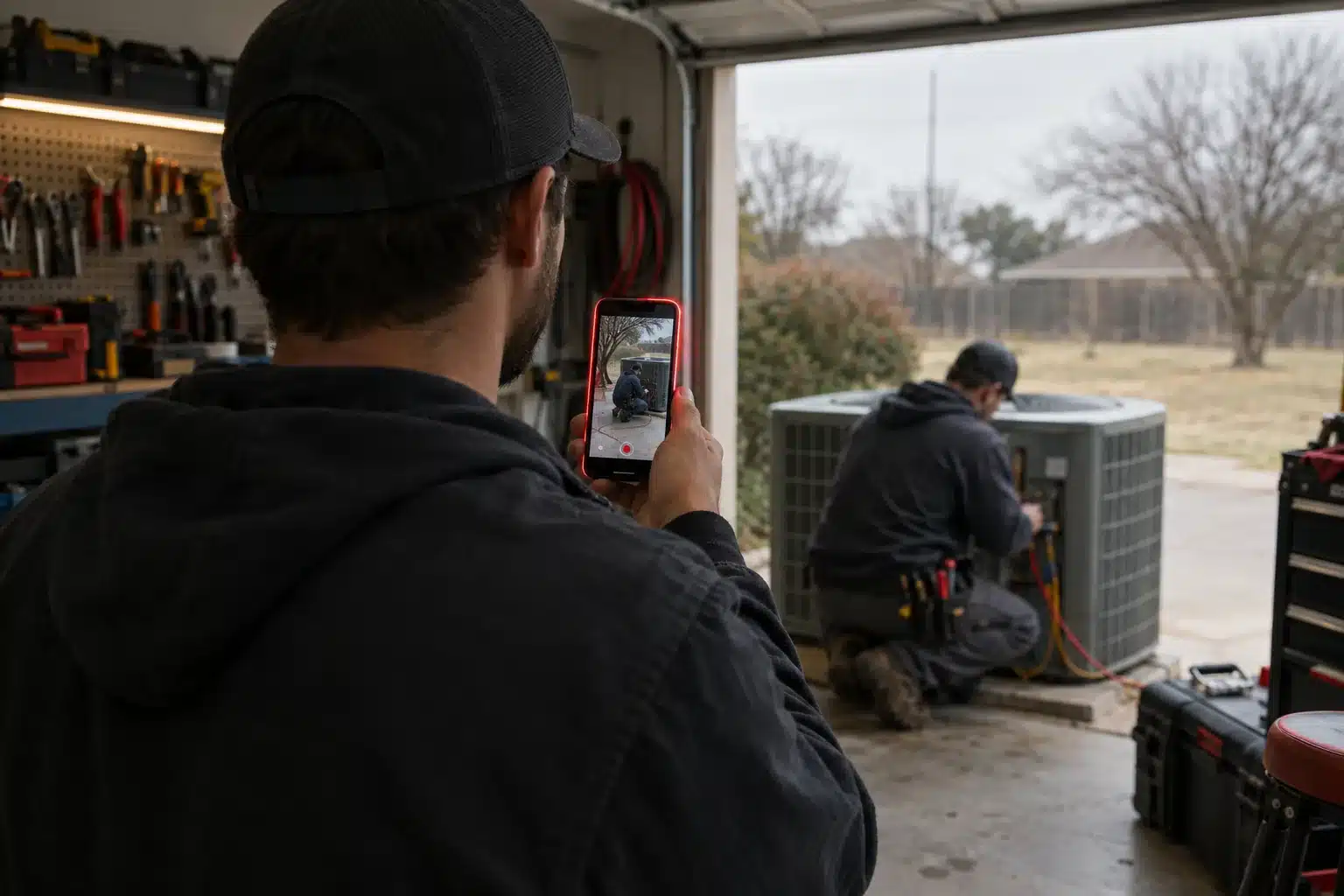
    Technician seen from behind filming a coworker at an AC unit with a phone held upright in a garage workshop.

    How to shoot it on your phone

    “Don’t we need real equipment?” comes up in almost every conversation we have about video. For weekly posts, no. A phone is enough if you get a few basics right:

    • Hold the phone upright. Short-form is vertical (9:16), and a sideways clip gets shrunk into a thin strip with black bars above and below.
    • Face the light. A window or an open garage door in front of you beats overhead fluorescents every time.
    • Get close to whoever’s talking, or clip an inexpensive wireless mic to your shirt. Bad audio loses people faster than shaky footage.
    • Trim the first two seconds of “is it recording?”
    • Turn on captions. Plenty of people watch with the sound off, and most apps will generate captions for you.

    Fifteen minutes of shooting and ten minutes of trimming in the app gets you a post. That’s the whole workflow.

    Save professional production for the pieces that have to carry weight for years: the homepage video, the customer story you’ll run as an ad, the walkthrough of your signature service. That’s where professional videography earns its cost. For the weekly stuff, your phone is fine, and nobody will think less of you for it.

    Film once, post in four places

    One vertical clip can go to Instagram Reels, Facebook Reels, YouTube Shorts and TikTok with almost no extra work. Upload the original file to each app. A Reel with another app’s watermark stamped on it looks recycled.

    Put the good ones on your Google Business Profile too. It accepts video, and a clip of real work sitting next to your reviews gives people one more reason to call you instead of the next listing.

    Then watch for a couple of months. Whichever platform actually brings calls or messages gets your best effort. The rest get the same clip and nothing more.

    A posting schedule you can keep

    One video a week, same day every week, beats a burst of ten followed by two months of silence. Tonight, write down ten ideas specific to your business. Most owners get there in about five minutes once they start listing the questions customers ask. That’s ten weeks of posts.

    Our one-hour-a-week social media system shows how video fits in next to everything else you post, and our social media management team can plan and post it if you’d rather not. If a week slips, post the next week. Nobody is keeping score but you.